Road to DMSC
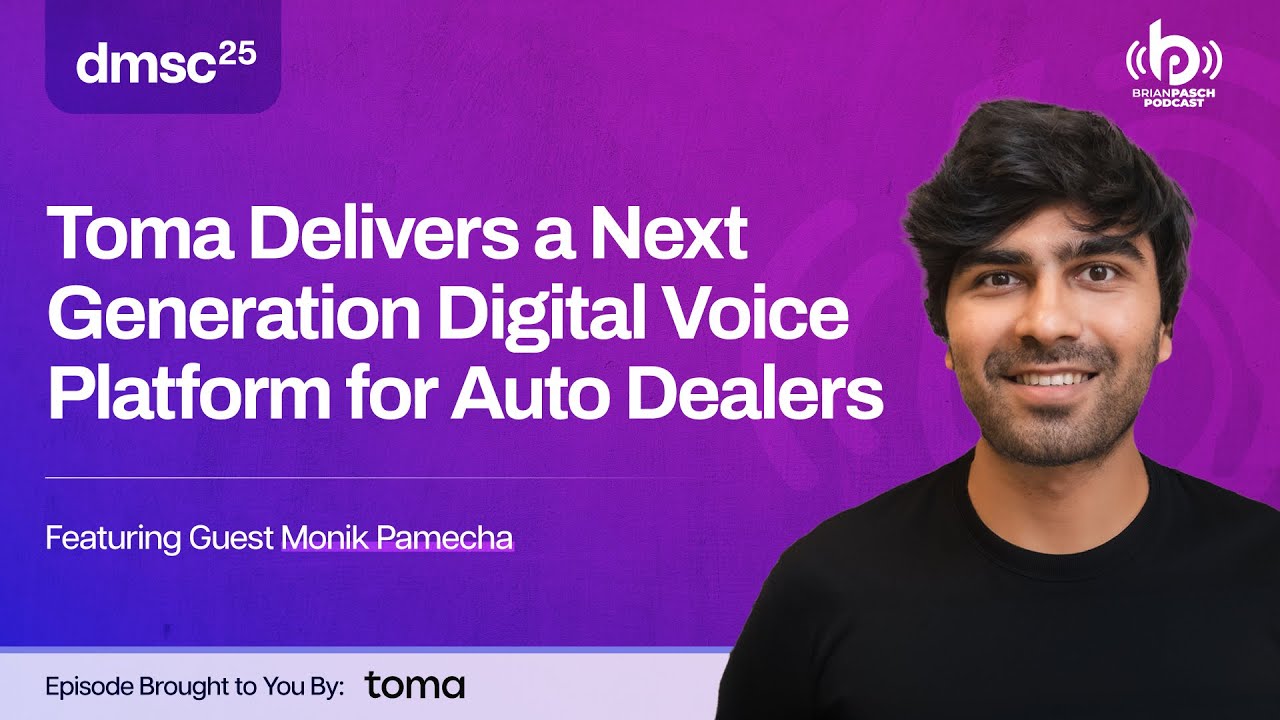
Toma Delivers a Next Generation Digital Voice Platform for Auto Dealers
Monik Pamecha explains how Toma's AI voice agents learn from each store, handle off-script service calls, use DMS data mid-call and call web leads fast.
- Released
- April 3, 2025
- Length
- 32 min
- Guest
 Monik Pamecha
- In collaboration with
 Toma
Toma
In short
Toma builds AI voice agents that answer dealership calls for sales, service, parts and recalls. Co-founder and CEO Monik Pamecha explains how an agent is trained on a store's own data and past calls, how it handles questions that go off script, and where outbound calls help, from recall waiting lists to calling a web lead minutes after it arrives.
- Monik says about 60% of service conversations go beyond the simple path. Test a voice agent on pricing and timing questions, not just oil changes.
- Connected to the scheduler, DMS or CDP, a voice agent can greet returning callers by name and ask which of their vehicles needs service.
- When a recall part is on back order, Toma can keep a waiting list of callers and call them back once the part arrives.
- Monik's newest use case: call a web lead about two minutes after an after-hours form, not the next morning when they're back at work.
- Context matters for outbound calls. A trade-in offer can help a customer facing a big repair and annoy one who just bought the car.
Chapters
- 0:00From AI research to car dealers
- 6:01Voice agents that keep learning
- 8:27Handling vague requests like a flush
- 10:56Customizing tone, offers and opcodes
- 13:15Languages and returning callers
- 17:03Service appointments and recalls
- 18:47Outbound calls that add value
- 22:59Calling web leads after hours
- 26:00Testing Toma at DMSC
The conversation
Why a voice AI company chose car dealers
Monik Pamecha, co-founder and CEO of Toma, worked on conversational models in 2016, when a model couldn't answer "how are you?" with correct grammar. Toma's first customers were a hospital, some banks and one dealer. Monik says dealers cared in a way the other industries didn't: they were willing to try it, and the pain was so acute that results showed up right away. He recalls one store saying its phone was ringing at least 50% less. Word spread after dealers talked about Toma at a 20 Group meeting, and Monik says the company didn't even hire a salesperson.
A voice agent that learns from the store's own calls
Brian hears from dealers who stopped using early voice tools because bugs and suggestions went unfixed. Monik's view is that great software has to keep evolving, based on how real customers react to it in the store, not only on the maker's opinions. He says older systems are rigid. Toma can be trained on how a store runs its business and keeps learning on its own: when it can't handle a call and transfers it, it keeps listening to what the staff member does next and learns from it.
That's not true with great software because great software is supposed to evolve.
Monik Pamecha▶ 7:16Handling the calls that don't follow the script
Brian's hypothetical: his wife calls the service department to book "a flush" for their BMW X5 before summer. Monik says the agent is fed the store's data and its past conversations, and uses automotive-specific models. It narrows the request by asking which flush, then checks the service record and suggests the likely one. If it still isn't clear, it invites the customer in, gives a price and books it. Monik says about 60% of service conversations go beyond the simple path, with questions about price or how long a job takes. That's where he says older tools break down.
Customizing tone, offers and booking codes
Brian asks how far a dealer group can make the agent sound like its own culture. Monik answers with a story: a configuration mistake set one store's agent tone to "be a cowboy", and within an hour the GM called because it kept saying "howdy". The customer still booked the oil change. Beyond tone, Monik says dealers can have the agent reference coupons they've just sent and set the exact opcode for a booking, such as a free oil changes for life program, so the whole call is configured end to end.
Language options and recognizing returning callers
Toma works with dealers in about 20 states, Monik says. For bilingual markets, the dealer knows who calls, so some stores open with an offer to help in English or Spanish, and the call continues in Spanish if the customer chooses. Stores can rotate five greetings and five voices so calls sound more natural.
Toma connects to schedulers, DMSs and CDPs that share data through APIs. A returning caller can be greeted by name and asked which vehicle the appointment is for, and the agent has the context of earlier calls. If someone has called four or five times, escalation rules can send the call to the service manager instead of the ring group.
Recall waiting lists and outbound calls customers want
Service appointments are the use case most dealers start with. Recalls are another: when an OEM announces one, calls flood in for a week and the part may be on back order. Toma can capture those callers in a waiting list the store can access, and can call them back when the part arrives.
On outbound calls, Monik says the balance is between being annoying and giving value, so Toma focuses on calls customers have consented to: appointment reminders, missed appointments and recall reminders. The agent can also give a trade-in range when a warranty is about to expire, though Monik says context matters. One buyer in the conversation got a "we want to buy your car" offer from an OEM program 30 days after purchase.
I think you have to strike a balance between being annoying and actually providing value to the customer.
Monik Pamecha▶ 19:41Calling web leads two minutes after the form
The newest use case, Monik says, is off-hours lead calling for sales. A shopper fills out a form at 9 p.m.; by the time staff call the next morning, they're at work and won't pick up. Toma can call about two minutes after the inquiry, answer questions and book a visit. Brian sketches the call: confirm the truck is in stock, give the sale price, mention possible incentives and offer an appointment.
Monik's approach to demos is show, don't tell. At DMSC, he says Toma would show cases where AI goes wrong and how it handles them, and challenge dealers to talk an agent into giving them a car loan. Brian asks dealers to bring their fears, such as an AI saying something that breaks compliance rules. Every Toma agent can be tried in the browser or by phone on the Toma website.
Dealers are chasing people all day long to get them on the phone. If you can call them when they've just submitted a lead, it's fantastic.
 Brian Pasch▶ 25:43
Mentioned in this episode
- PGDigital Marketing Strategies Conference Event
- CChatGPT
- GGrok
Questions this episode answers
What is Toma?
Toma makes AI voice agents that answer dealership phone calls for sales, service, parts and recalls, and can make outbound calls. Monik Pamecha is its co-founder and CEO.
Can a dealer customize Toma's voice agent?
Yes. Monik says dealers can set the agent's tone, greetings and voices, have it reference current coupons and set the opcodes used for bookings. The agent also learns from calls it transfers to staff.
Does Toma handle Spanish-speaking callers?
Yes. Monik says AI can speak any language; the question is how to offer it. Some stores open with a greeting that offers help in English or Spanish, and the call continues in the caller's choice.
Which dealership systems does Toma connect to?
Schedulers, DMSs and CDPs that share data through APIs. Monik says that lets the agent greet returning callers by name and know their vehicle, VIN, appointments and earlier calls.
Can Toma make outbound calls?
Yes. Monik says Toma makes calls customers have consented to, such as appointment reminders, missed appointments and recall reminders, and can call web leads minutes after they submit a form.
How can an AI voice agent help with recalls?
When a recall floods the phones and parts are on back order, Monik says Toma captures callers in a waiting list the store can use, and can call them back when the part arrives.
Transcript
Full transcript5,381 words · about 23 min read
Brian Pasch0:00Hi, this is Brian Pasch, and welcome to another exciting podcast session. On today's show, we have a new tech leader, one of our showcased vendors at the Digital Marketing Strategies Conference coming up April 27, 28, and 29 in beautiful Scottsdale, Arizona. The company is here. The name is Toma, and Monik is the CEO, and he is here today to demystify AI, talk about what their platform is doing to elevate the use of AI in answering phone calls for sales, service, parts, recalls. We're going to talk about it all today. Monik, welcome to the show.
Monik Pamecha0:52Hey, Brian. Thanks for having me.
Brian Pasch0:53You know, you know, dealers have heard about digital voice assistants or AI-powered communication solutions, and we're going to dive into your platform today. But let's just pause for a minute. Your background is very interesting. In fact, you've been working on AI since the early days. So before we talk about the birth of Toma and what you're doing for dealers, can you give us a little background on your research and scholarly work on AI?
Monik Pamecha1:28Yeah. So in 2016, I did a lot of research work on conversational models, which is really what is powering everything that you see around today, right? With ChatGPT and like, you know, all of these like video generators and image generators. It was really simple in like, let's say in 2015, 2016, it was like, here's one sentence, and that's the input. And here's the output, which is another sentence. So, hey, look at this, memorize this and map it to that. And then when I give you a new sentence you've never seen before, let's generate something else. And it was so like rudimentary. It was so basic at the time.
Monik Pamecha2:11And it couldn't even get grammar right. So let's say if I said, how are you? The response was good. I am. Right. And we've come a long way since then to today. But that was like a big focus of my work at the time. I think I was like, I think I was like 20 or 19 or something at the time anyway.
Brian Pasch2:31So years of research, building models, working with Google and other large investors in AI. When did the entrepreneurial light go on and say, hey, I think I want to start my own company?
Monik Pamecha2:49Well, I mean, that started long back. When I was 13, I used to write like a tech blog and I used to make websites. So I had all of these random customers in different parts of the world. I made a social networking website for somebody, a health instructor in Central Park. And we made these websites for everybody, whoever, whatever sports they would play, they would come by and like, you know, you know, network with each other and find games to play. And so I was always like selling stuff since I was like 13 or 14. But it's always been there, really. And I think I met my co-founders, you know, a few years ago.
Monik Pamecha3:27We kept experimenting. We kept working on different ideas. But we landed on AI Voice like two years ago. And that was it. I mean, we were like, this is a really hard problem. And it's everywhere around us. Like, you know, what can we do? And yeah.
Brian Pasch3:43And so why automotive? You know, the automotive vertical is very challenging. And also, there have been some early companies bringing digital voice assistants, AI communication tools and automotive. What was the pivot when you and your partners started solving this problem to say, hey, this is perfect for automotive?
Monik Pamecha4:10Our first customers were actually, we had a hospital that worked with us. We had some banks and we had a dealer at the time. And I think the big difference was the dealers cared, like in a way that the other industries didn't. They were slow.
Brian Pasch4:29Right.
Monik Pamecha4:29But, well, you know, I think the dealers were progressive in the sense that we had something that kind of worked. And they were like, let's try it. Let's see what happens.
Brian Pasch4:37Right.
Monik Pamecha4:38And I think the pain that the dealers felt was so acute.
Brian Pasch4:42Right.
Monik Pamecha4:43So it was like immediate, like, OK, great. You know, my phone is ringing less, at least 50 percent less. That is amazing. That is really a big benefit. So I think it kind of like and then I think they went at the 20 Group meeting and they spoke about us and then we had more customers and more customers. Like we didn't even hire a salesperson like.
Brian Pasch5:05Listen, the best the best stories in automotive are like that. And, you know, when I think about when I first started my digital marketing agency, I went to lawyers and doctors and I was doing microsites. This is 2005 and, you know, trying to help with SEO and although the clients I had appreciated, the car dealer loved it was like, I want more leads. I want to show up in search. They were like super passionate. And I do know that the dealers listening to today's podcast have been struggling to fix their phone problems. Those inbound calls, especially for those simple, repetitive tasks of booking service, checking on the status of their car, setting a test drive appointment.
Brian Pasch5:52All of those things 24-7 is a little overwhelming and dealers know they're not doing a great job at it. One of the challenges I've heard, Monik, is that the tools that are out there haven't been evolving fast enough, meaning dealers were awesome and excited. But some of them, it's like, yeah, I used to use this product, but I stopped using it. I'm like, why? It's like, well, you know, there were some bugs and I made some suggestions. How is Toma going to be different in the marketplace so that a high-end dealer who's looking for a certain type of experience from their AI digital voice assistant or, you know, an import dealer is looking for something in a bilingual community like Miami?
Brian Pasch6:49How are you handling the AI learning models and platform performance improvements?
Monik Pamecha6:58Yeah, I think that's a great question. Like, why? And I think that's a sign of, like, things to come in the future as well, which is, you know, previously you would buy software. You'd buy something like, you know, I bought this coconut water. Like, that is it. That is, it is what it is and I drink it and I finish it. But that's not true with, like, great software because great software is supposed to evolve, right?
Brian Pasch7:21Right.
Monik Pamecha7:22Not just based on the maker's opinions. Like, you know, I think it should be different. That's great. You know, I can change it. But what about, like, when I put it in the wild, when you put it in the store and your customers are reacting differently to it and you need to learn from that? Yeah, so I think the place where Toma differentiates itself from, like, all of the, I think, older generation solutions is that Toma can adapt to inputs. It can be trained to a specific store to the nuances that you may have, you know, how you run your business, right?
Brian Pasch7:50Right.
Monik Pamecha7:51And it can become better and better. So unlike old generations, they're more rigid. They're not flexible. So that limits their ability in, like, how much they can help the customer and what are these unknown scenarios that it can take over, right? So I think Toma excels at that. You can teach it. Like, that's the big difference. And it learns silently. Just, you know, you have all the customers calling in. Oh, I wasn't able to figure it out. Let me transfer that call. And then it still is listening to what happens after the transfer. And then it's like, that's what I got to do. And there you go.
Brian Pasch8:27So let's talk about this. I'm just going to make up a hypothetical. Maybe the summer season is coming up here in Florida. And I tell my wife, hey, we should schedule to get a coolant flush, you know, of the car. And she said, okay, I'll take care of it. She calls up the dealership and said, hey, my husband said I should schedule a flush for the vehicle for summer. How does Toma understand, like, flush? Is that flush the toilet? Is it flush what? You know what I mean? Like, I think sometimes the examples that are given for digital voice assistants are like, hey, I'd like to make an oil change.
Brian Pasch9:16You know, what do we do when people are just people and the AI is trying to determine, you know, what flush means for that, you know, BMW X5?
Monik Pamecha9:29Right. So I think a big part of human conversation is ambiguity. And a lot of it comes from, like, shared context, right? Like, you expect somebody else to kind of know. You're calling a dealership. They're at the store. You know, they're picking up. You should know what a flush is, right? But that's what's true with all AI agents. But in our case, I mean, we feed it with all the data already and we feed it with all the past conversations that you've ever had. And also, like, our models are automotive specific. So, like, you know, a Toyota, a Kia, a Kia, you know, how you pronounce it.
Monik Pamecha10:00Like, every single thing has been factored in. But let's say you started with, like, hey, I want a flush, right? Next question is, what kind of flush? Do you want, like, a coolant? Do you want a brake fluid flush? Like, which one are you looking for? And the customer is like, I don't remember. So the next step is, hey, wait a second. Let me pull up your record and see what you have over there, right? And then, oh, all right, I see. You haven't gotten a brake fluid flush in, like, you know, 5,000 miles, for example. Maybe that is what you're looking for. Is that what you want to do?
Monik Pamecha10:31And then the next question would be, just tell me a little bit more. Why do you think that's the case? Or, you know, I think you kind of narrow down and work with the AI to figure out that answer. And then go ahead and book it, right?
Brian Pasch10:42Right.
Monik Pamecha10:43And if, in cases where you don't know, hey, how about you come to the store? We'll check it out. It'll be one of the two. This is how much it costs. So you don't need to worry that much. Just come through and we'll take care of it.
Brian Pasch10:54Right. I love that. You know, one of the things that I've been doing lately is doing some consulting with CDP projects and trying to bring data inputs in. And some of my smarter clients, thinking of one right now, you know, is really fascinated with the potential of AI and really focus on how much can a dealer help accelerate the learning, right? You know, especially some dealers have a value-added package or a certain concierge process. And what I'm hearing from my customers is, how much can I personalize it? How much freedom do I have? How would you answer that for a dealer who says, man, I get what you got, but I really want it to be
Brian Pasch11:46personalized to our group culture, the way we speak, the way we talk about our customers. Like, how much could they really impact how the AI is communicating with customers?
Monik Pamecha12:00I'll tell you a funny story. What happened was we had added a new feature like maybe seven months ago, which would generate an image for the AI agent. And then we made a mistake. We copied that into, we had a section where you could configure the tone of the agent. And it said, be a cowboy. It just said, be a cowboy. And like, you know, about an hour later, we get a call from the GM saying, hey, the AI is behaving like a cowboy. Because all it was saying is like, howdy. And, you know, like, and the customer did book an oil change. But the funny thing is, like, that's the degree to which you can change the tone.
Monik Pamecha12:38You can give instructions. Like, if you wanted to be like, you know, a retro feature artist, something like that, like, it would act like that. It would sound like it, it would behave like that. So in short, you can change everything, like, which means that maybe you have an oil change for a free program, right? And you have some coupons that you just sent out. You want to make sure you reference that. That's great. You can say it. But what about the booking portion, right? Because now you need a very specific opcode that you want to put in, right?
Brian Pasch13:06That's right.
Monik Pamecha13:07You know, the old ones, right? So you want to put the free oil changes for life opcode. So you can configure it end to end to do the whole thing.
Brian Pasch13:15What about language? What about language barriers? You know, I mentioned Miami, but I'm thinking of different areas. Our clients in Brooklyn, you know, they'll have sections where there's a big Korean population or Chinese population and down in Miami, you have a big Cuban and Spanish, you know, influence. These different pockets, when someone calls in, are you assuming that if they're calling in the dealership, they're going to be able to understand an initial English prompt? How do you adapt to different voice, language patterns?
Monik Pamecha13:57Yeah. You know, great question. Again, as we work with, like, I think about in 20 states today. So we've experienced, like, a lot of these different situations. The short answer is the dealer knows exactly who is going to call, right? So I think we work with them as we work on the prompt. So some stores, for example, have opening prompts which say, you know, we can help you in English or Spanish, and we just are upfront about it. Like, in terms of technology, like, you know, AI can speak every single language better than any of us will ever do that, right?
Brian Pasch14:28Right.
Monik Pamecha14:29The challenge is how do you convey it to the customer? And that is the piece that we work with you on, which is, you know, how do you want to greet the customer? And, you know, in our platform, you can change that. You can have five different greetings each time somebody calls. You can have five different voices each time and make it just seem like more natural. So you can work on that and have them the ability to, like, you know, let the customer know, okay, if you want to speak Spanish, I will help you. And then the customer speaks in Spanish, and the call just works.
Brian Pasch14:58What about tying into, like, a CDP or a phone switch so you know the inbound number, you know, the phone number of the people who are calling, to do a data dip and maybe say, oh, this is a customer who always speaks in Spanish, or this is one of our Korean brokers. Any built-in connectivity that an inbound call could do a data dip to, you know, even personalize, like, welcome back. Like, with Delta, you know, it's like, welcome back, Brian Pasch. Thank you for your diamond medallion status. What about that type of, you know, first glance, making someone feel recognized when they're calling in?
Monik Pamecha15:41So we work with a lot of schedulers, DMSs, and, you know, even CDPs as they expose that data through APIs to us. When you call in, if you're a returning customer, we already know your name, we know what card you have, we even know your VIN, your existing appointments. In many cases, the clients, like, we have everything, right? So the call usually begins with, like, hey, Brian, you know, thanks for calling. Are you calling to book an appointment? And if you say yes, so is it for your Honda Civic 2012, or is it for your, you know, Honda Accord 2025, right? And then that's how the conversation really flows.
Monik Pamecha16:17So we're able to pull information before, during, and even after the call.
Brian Pasch16:21Right. All the data sources.
Monik Pamecha16:25Not just that. Like, if you've called us, like, five times, we have the call context of every single time you call before. So if you're calling, like, the fourth time or fifth time, and you're like, look, man, I already tried getting in touch with someone. I haven't heard back. You know, the next thing is, you probably want to escalate this call, you know, instead of, like, letting it run into the ring group. Like, this time, it needs to go to the service manager. You can have escalation policies routed to the right person. So I think AI has more memory than any of us combined will ever will.
Monik Pamecha16:56The challenge is that, can you use it to help your customer, you know, and that's where we come in.
Brian Pasch17:02Great. So let's talk about use cases. When dealers see a demonstration of the platform, and dealers can go to toma.com, an amazing domain, can't believe you got a four-letter domain, but what are the, say, top two use cases that dealers want to implement first?
Monik Pamecha17:29So I would say, like, definitely, like, service appointments, right, is one big popular use case, and obviously the happy paths are easy to do here. I want to book an oil change. That's so simple. But, like, anytime you deviate from it, you ask a pricing question. You ask, how long does something take? You ask anything beyond, like, the basic stuff. Stuff just breaks down. And in reality, like, about 60% of the conversations are like that, right? So we're able...
Brian Pasch17:57We're not linear.
Monik Pamecha17:58Yeah. And that's the nature of conversation, right? Like, because we like to talk. We like to give information, get information. But so that's service appointments. But there are more specific things, like, around recalls, right? Like, when you have a Honda or, you know, any of the OEMs go out and announce a recall, you're flooded with, you know, calls coming in, like, for the next week, right? And you cannot handle it. That's a great business. You don't want to miss out. And maybe the part is on back order. Like, what are you going to do, right? You just lose that business. Well, no, you know, we have a solution for that, which is we can capture all that business
Monik Pamecha18:30and then store it and then keep, like, a waiting list that your store can access, right? When the time is right, you can... We let them know that we'll call you as soon as we have the part in stock. And here you have the list. So the moment you have the parts, you start calling them. And you could even use Toma to call them back and notify them, by the way.
Brian Pasch18:47Oh, yeah. That's why I wanted to ask. Where are you with outbound calling? You know, I've seen some of what I'm going to call first-gen digital voice assistants. They've been at our conferences. I have clients who are using them. And most of them have said, yeah, we're going to move. Our next step is to start doing outbound calling, like declined service, recall. You know, they haven't been in, you know, missed service. Where are you today in testing the ability maybe to receive a signal from a CDP? Hey, give this person a call. Or just using normal service scheduler or recommended service schedule maintenance calendars to do outbound calling?
Monik Pamecha19:36So we can do outbound calling today. And in fact, we do, like, pretty specific use cases. I think you have to strike a balance between being annoying and actually providing value to the customer. Because, I mean, if we were getting spam calls or, you know, any sort of, like, calls that we didn't sign up for, that would be pretty frustrating. So it's, like, I think the balance is, like, how do we get consent in a way where a customer, you know, is going to get value from it? And then we execute that. So appointment reminders, missed appointments, or those specific use cases. And even recall reminders, right, when you call in and you know the part is not available.
Monik Pamecha20:11So those are, like, really valuable ones where, you know, we're able to do great. And we're live with them today. So plenty of our customers use that.
Brian Pasch20:19Yeah, I mean, if I was driving a car and had a recall, I might miss it in the mail, think it's junk mail and throw it out. I would have no problem receiving a phone call and say, hey, Mr. Pasch is calling you to let you know that your, you know, car is under current recall. And we have the part, we're ready to schedule. Would you like to schedule? I mean, I think that would be a high value call. I probably wouldn't be doing it and say, hey, we want to buy your car or you want to trade in. You know, I probably would do that with a real person.
Brian Pasch20:52But maybe I'm just old school.
Monik Pamecha20:54Funny that you say it because we're even able to pull information. So, for example, you booked an appointment and let's say you're coming close to your, you book like maybe 40,000 miles or something like that. Whenever your warranty is expiring, you could come, you could have a trade in valuation be given to you on the phone itself, which is like the AI would just be like, hey, you know, just so you know, this is the range, you know, that you, you'd be able to trade your car. And like, I mean, if you're interested, you know, we could help.
Brian Pasch21:23Right. I love that. Listen, I think every time you talk to a customer on something transactional or a reminder, adding some value would be fantastic. I mean, I think if you're saying, hey, it's service reminder call. Hey, just calling to remind you. I get them for my dentist or eye doctor. Right. I get all those. But, hey, by the way, when you come in, if you are thinking about upgrading your car, we have great selection in stock right now. And your car is worth, you know, between $45,000 and $50,000. I think I would consider that a value add. What do you think?
Monik Pamecha22:01I mean, so that's just a starting point, right? It's very contextual. It depends, right, where you are in your journey. I mean, if you have a really massive repair that you're paying for, then those words would be music to your ears, right? Like, hey, I can't do this, right? Or maybe, I mean, obviously, it's annoying if, like, you just bought the car. Like, why would you want to trade that in, right?
Brian Pasch22:22Listen, it's funny you should say that. I recently bought a car from a friend who's an owner. And I got an offer, which was an OEM program. I mean, I just bought the car. And 30 days later, it's like, look, we want to buy your car. And I sent it to him. And he got so mad. And he called up the company, which we won't name. And he was like, is this your crap you're sending out? This is a brand new customer, you know? So, right, it's the context that is super important. What other use cases can your platform be used for? What's something you're kind of like, hey, I would love more dealers to lean in in this
Brian Pasch23:09area because you're excited about it?
Monik Pamecha23:12So, I think the newest use case and the one that dealers are most excited about is off-hours lead calling for sales. That is interesting because, hey, you have somebody having a drink at 9 p.m., talking to their wife. And they look at this amazing truck. And the next thing is, like, all right, let me get that. They fill a web form. And obviously, the night goes by, morning, they're back to work. They're not going to pick up your call. But, like, if you were using Toma, what you could do is you could trigger a call like two minutes in as soon as they, you know, book, submit an inquiry.
Monik Pamecha23:47And the next thing is, you're talking to them, giving them information, and you book them in already. You come in tomorrow.
Brian Pasch23:53I love that.
Monik Pamecha23:55So, it's like, it goes back to what you were saying before, which is like the right message at the right time really changes everything, right? And that's something that we're good at. We can take in these signals from you and make the calls and make the, you know, transactions that you wanted to make without waiting.
Brian Pasch24:12That's right, because if you think of most dealer websites, let's look at it tactically now. Somebody goes, they still, dealers have, you know, get e-price or get today's price. And so, the person, it's nine o'clock, they fill out the form, right? Someone's not going to get back to them until the next morning, typically. So, you know, now 10, 12 hours passes by. But what they really had is some specific questions like, hey, what's the price of the vehicle? Is it in stock? And if I got an automated call that said, hey, see, you have an interest in this 2025, you know, Ford F-150, is there any questions I can answer for you?
Brian Pasch24:54You know, like, hey, is it in stock? Yeah, according to our inventory, it is in stock, just as it's described on the website. How much is the car? And this is the, you know, the tricky part, you know? I think consumers want some transparency. Say, okay, the car's current sale price is this, but you may qualify for, you know, loyalty discounts or rebates or incentives, which we can discuss with you when you come into the dealership. You know, would you like to book a time to come and see the car? You know, like, if that's happening at 9, 10, after they filled out that form, there's
Brian Pasch25:32a chance, and of course, this is where I love testing. You know, even if you've got 10% of those people to book an appointment, right? Dealers are chasing people all day long to get them on the phone. If you can call them when they've just submitted a lead, right? It's, you know, it's fantastic. So, I love that idea of testing that technology. You know, Monik, we have a conference coming up.
Monik Pamecha26:04Yep.
Brian Pasch26:04You and your team are going to be in Scottsdale talking to dealers. When they come up and see you, are you going to allow them to call in and kind of kick the tires and put it to the test? I'm interested to see how you like to demonstrate your technology platform to dealers who have interest.
Monik Pamecha26:29So, we believe in show, don't tell. If you go to our website right now, Toma.com, like, every AI agent is up there. You could, like, click on it and talk to it in your browser. You want to call it, there's a phone number, you can call it. But at the conference, at least, when you come to us, we'll have some fun challenges for you. For example, we have some of these AI agents where you have to convince it to give you a loan on car. Like, you will have to really, really try hard to give you a loan on car. And, you know, those are just some fun ways in which you can understand, like, the AI's
Monik Pamecha27:03ability, like, how much we can customize it, first of all, and how natural and fluent that is. And also, we like to talk about cases where AI goes wrong. Because I think everybody talks about, hey, these are the, you know, cut and dry, like, book an oil change, do this, just book me an appointment. That's great. But what happens when things go wrong? And I think for us, we're pretty upfront and showing you, like, all the cases where it can and how we mitigate those scenarios.
Brian Pasch27:31I love that. Because, you know, there's a lot of confusion. There's some fear. They don't want the AI to go rogue or say things that could get them into trouble with compliance or local, state, or federal laws. So I love that.
Monik Pamecha27:49Yeah.
Brian Pasch27:49So I'm going to encourage dealers who are coming out to DMSC, come by the Toma booth, put their tech to the test. But more importantly, talk to them about your fears. Anything that's holding you back for testing or a more fully committed investment in using AI in the dealership. I think what's so nice about your experience is you've been doing this for a long time. You were there building early, early models when it was so rudimentary. And now today, I mean, I get a kick out of the image generation. I just generated an image for an article I published today. And I, you know, I just went to Grok and said, hey, give me this image.
Brian Pasch28:34I just like, wow, that saves so much time of me trying to look through a clip art library or try to force an image. I mean, the time savings is amazing.
Monik Pamecha28:46If I may ask you, how many times did you have to try to get that image right?
Brian Pasch28:50It took me about six times.
Monik Pamecha28:53Okay. So, and I think just to give you a glimpse of the future, what happened is that it would probably would have taken you 20 times last year, six times now, and it's going to take one time in like a year. And that's really the progression of AI.
Brian Pasch29:08Love that. Well, I'm so excited for you and Chris Vazquez to come down to Scottsdale to be at the show. You're in our showcase of our new vendor partners strategically coming out to DMSC to meet with dealers and dealer groups. You mentioned it's Toma.com. If they wanted to send you, Monik, a email, what's the best email? Because sometimes the top brass at dealer groups want to talk to the boss, not a salesperson. How do they get in touch with you?
Monik Pamecha29:46Well, it's just my first name, Monik at Toma.com.
Brian Pasch29:50Wow. You know, you're making it way too simple. Hey, I want to thank you for giving your time today to talk about your platform, get dealers excited. For the dealers who are listening in or watching today, if you're not going to DMSC, what are you waiting for? Go over to Toma.com, get a demo, see what can be possible at your dealership, especially with the advice that Monik is giving to ask them the tough questions. Let them show you how they can customize and you can customize the prompting and responses and workflows within the AI engine. It's an exciting time to be in automotive retail. And if this is the first time you're listening to one of my podcasts, you should know I have
Brian Pasch30:39hundreds of interviews with automotive leaders, entrepreneurs, and breakout companies that are working to improve modern retailing. So listen to the entire series as we lead up to DMSC or past ones, because man, there's a lot of great conversations. Monik, have you been to Scottsdale before?
Monik Pamecha31:01I have not.
Brian Pasch31:03Okay. Get ready for beautiful weather and an amazing resort. So we can't wait to welcome you and your team. So for the dealers listening in today, thanks for your time. Come on out to Scottsdale, learn with us so we can elevate the customer experience and to run our dealerships more profitably to help you sell more cars and service in a digital age. Thanks for listening in.
Ask your AI about this episodeOpens your assistant with a summary prompt and a link to this page.
More episodes
All episodes- Sep 27, 2026
Foureyes Empowers AI Builders: The Next Generation of Retailing Software Is Here
Dealers built dashboards and apps on Foureyes' open data platform at the Claude for Dealers workshop. What they learned about data access and trust.

 David Steinberg, Melody Edwards
 Foureyes41 min
 - Sep 23, 2026
AI Builders Now Have API Access to the Active Shopper Network
Client Command opens its Active Shopper Network to any dealer, vendor or AI builder through an API, so call lists and audiences start with real intent.

 Megan Horton, Wally Burchfield
 Client Command28 min
 - Jul 16, 2026
Dealers Need Technology Partnerships to Manage Their First-Party Data
Clean data, security guardrails and extra engineering: how FPT Americas helps dealer groups and vendors build on first-party data without waiting.

 Charlie Daniel, Chuck Bratton
 FPT Americas35 min
Never miss an episode
Follow the Brian Pasch Podcast wherever you listen.