Brian Pasch Podcast
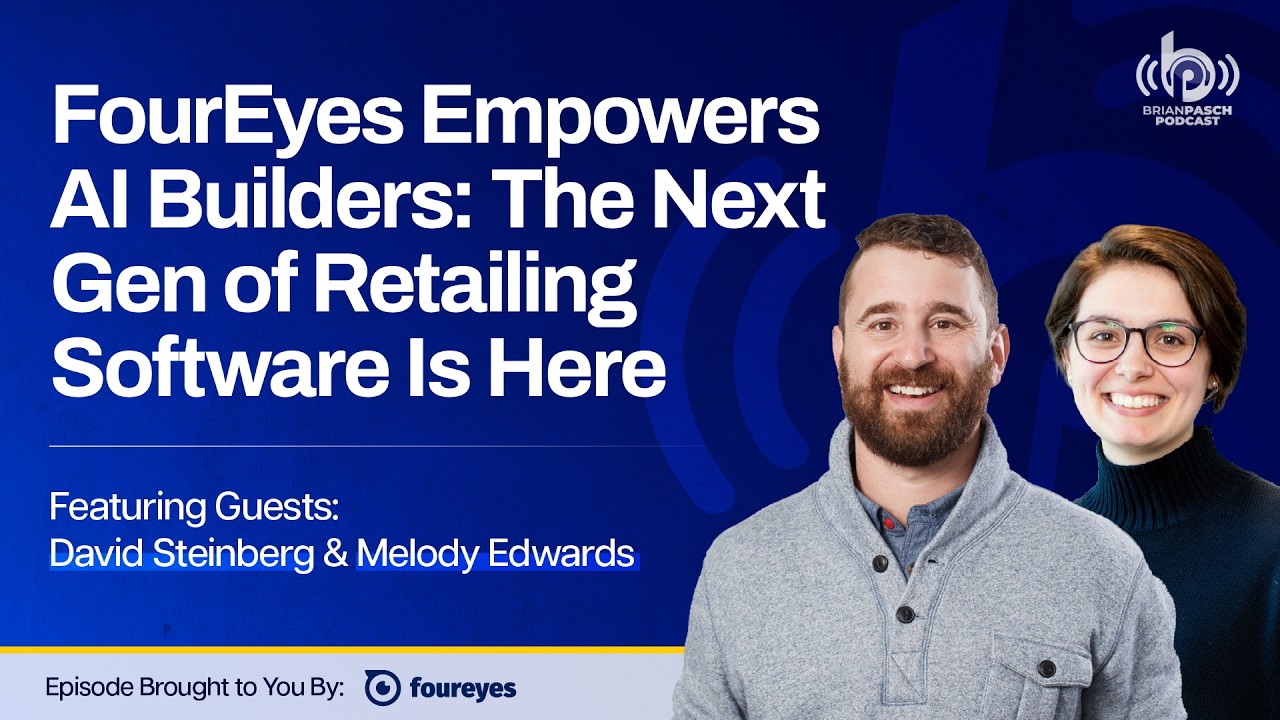
Foureyes Empowers AI Builders: The Next Generation of Retailing Software Is Here
Dealers built dashboards and apps on Foureyes' open data platform at the Claude for Dealers workshop. What they learned about data access and trust.
- Released
- September 27, 2026
- Length
- 41 min
- Guests

 David Steinberg, Melody Edwards
- In collaboration with
 Foureyes
In short
At the Learn Claude for Dealers workshop in Atlanta, dealers built dashboards and working apps on Foureyes' open data platform. David and Melody explain why walled-garden software holds dealers back, why incomplete data looks complete to AI, and how Foureyes sets up a dealer's data so tools like Claude can use it.
- David says software that under-delivers is usually a data access problem: the vendor can't reach the dealer's data through the walls around it.
- Incomplete data looks like complete data. Before trusting an AI marketing report, check that every website tool sends conversion events into GA4.
- Melody's advice is to bring dealer skepticism to building, because AI presents unbaked findings with the same conviction as fully vetted ones.
- Judge an MCP server by what it knows about the data, not the label. Melody expects MCP everywhere on the NADA floor next year.
- Before any email campaign, check deliverability, bounces, do-not-contact status and recent sends. Brian says an API layer around your data should handle this.
Chapters
- 0:00Recapping the Claude for Dealers workshop
- 1:34Why Foureyes built an open platform
- 4:48What dealers built in two days
- 9:19Why dealership software under-delivers
- 11:55Incomplete data looks like complete data
- 16:26Vendors without real APIs or an MCP
- 25:18Setting up a dealer's data for AI
- 30:45Getting past the intimidation factor
- 34:46Getting started, security and what's next
The conversation
Why Foureyes chose open data access over a walled garden
David traces the problem to 2016 and 2017, when the rest of the economy was bringing its data together and automotive went the other way. After the Authenticom lawsuit, he says, the industry put up walls, kept data in silos and charged tolls for access. Private equity then saw software companies that could upsell locked-in dealers from $2,500 to $15,000. That is the opposite of how AI wants to consume data.
His view is that no automotive software company will build everything a dealer needs, and trying to is like buying an all-in-one printer. Foureyes focuses on access and connectivity instead. He describes dealer groups paying $2,500 a month for redundant technology across 10 to 20 stores who realize they could pay $30 a month at the group level for a better application.
What dealers built at the Learn Claude for Dealers workshop
The two-day workshop in Atlanta was set up for building. Gray Scott opened with AI building blocks and terminology, Brian showed dealers how to create and use a database, and others built marketing automation dashboards and OEM incentive and offer tools. The Foureyes build took a little under two hours, and with the app tools in the Foureyes MCP server, people deployed production applications straight from a Claude chat.
Melody's standout moment came from a dealer who said that asking people inside the store for answers always came with their bias and agenda. With direct access to their own data, they could get a real answer and look for the root cause themselves. Brian adds that dealers tired of 12 different agency reports could build their own dashboards with drill-downs.
When dealership software under-delivers, the cause is data access
By the end of the workshop, Brian saw more energy and enthusiasm for working in automotive retail, and he pushes back on people who belittle the industry by saying dealers can't build software. He met attendees who know their DMS, CRM and marketing automation inside out, and he sees several builders in one dealer group as collaboration and a competitive edge, not a risk.
David says dealers have seen many great demos followed by software that under-delivers, and calls that a data and access problem: the vendor's software can't get to the dealer's data through walls the dealer doesn't know are there. Now that AI has solved the coding problem, solving data access is what lets dealers move. Changes that used to sit on a vendor's roadmap for two years are now a keystroke away.
Now that AI has solved the coding problem, if you solve the access to the data problem, it makes you able to fly.
David Steinberg▶ 10:47Incomplete data looks just like complete data
Brian argues that builders need a new skill: knowing whether their data is fresh, complete and deliverable. Claude can build a marketing dashboard quickly, but if website tools aren't sending conversion events into GA4, the report is wrong. Claude won't know that voice conversions were missing for two months or that a trade tool stopped reporting. He says his KPEYE MCP tells you which stores have complete data and which need fixing before any analysis.
Melody's answer has two parts. Dealers are good at being skeptical and should bring that to building, because AI presents unbaked findings with the same conviction as vetted ones. The other part is a smarter connector: the Foureyes MCP server includes a semantic layer that teaches Claude how to query complicated dealership data, rather than only making the data available.
AI generally sounds really convincing when it talks to you about things. It will present things that are unbaked with the same level of conviction as how it talks about stuff that is fully vetted and fully baked.
Melody Edwards▶ 14:22Software vendors without real APIs or an MCP risk being replaced
Brian sees dealers building their own chatbots, trade tools and payment tools, often because their vendor will only sell the data as part of its package. Large and small groups, including Penske and Garber, were at the workshop building. David expects much of today's software to go away: a lot of it is a workflow with reporting around it, and he says that workflow can now be coded in Claude Code with the Foureyes connector in 10 minutes.
Melody adds a caution. She expects MCP everywhere on the NADA floor this coming year, and dealers will need to ask whether a connector just checks a box or carries the intelligence it needs to be useful. Brian agrees: he can spin up a basic MCP server that reads a data set in 10 minutes.
Talking to your data and asking the next best question
Brian gives an example. A dealer at Morgan Auto Group asked him to look at a struggling store. He asked Claude, through his KPEYE MCP, to review everything tracked for that store over 60 days and give a step-by-step plan, and sent it five minutes later. He expects more dealers to want to talk to their data rather than read a full report.
David says people think good data's job is to answer questions, but its job is to help you ask the next best question, because that is usually where the problem gets solved. Most dealer reporting ends in a data dead end. He also warns that asking Claude or ChatGPT to do the data management itself gets expensive and error-prone; the data management platform should be set up first.
People think good data's job is to answer questions. That's false. The job of good data is to ask the next best question.
David Steinberg▶ 22:08Collect, connect, visualize, activate: setting up data for AI
David lays out four stages of working with data: collect it, connect it, visualize it and activate it. Automotive has mostly jumped to activation. Foureyes starts by connecting phone calls, inventory, the website, the DMS and the CRM, stores the data in Snowflake or whichever warehouse the dealer wants, and wraps an API layer around it for sending messages, monitoring consent, recording activity and building campaigns that Claude can use.
Brian translates that for an email campaign. Without an API layer, a builder has to check every address: is it deliverable, malformed or misspelled, what mail gateway does it go through, is the person on the do-not-contact list, and did they get an email in the last 30 days. With the layer in place, a request such as a lapsed-service campaign handles those checks.
Mentioned in this episode
- PGClaude for Dealers Event
- PGModern Retailing Conference Event
 KPEYE
KPEYE Snowflake
 Authenticom
 UVeye
UVeye- ZZeroBounce
- GGoogle Analytics 4
- CClaude
- CClaude Code
- CChatGPT
Questions this episode answers
What is the Foureyes MCP server?
It's the Foureyes connector that lets Claude work with a dealer's data. Melody says it includes a semantic layer that teaches Claude how to query the data well, plus app building tools that let workshop attendees deploy production apps from a Claude chat.
Can dealers build their own software with AI?
At the Learn Claude for Dealers workshop in Atlanta, dealers built dashboards, offer tools and working apps over two days, and the Foureyes build took a little under two hours. Melody says the intimidation factor fades quickly when people build alongside others.
Why can an AI marketing report be wrong?
Incomplete data looks like complete data. If website tools don't send conversion events to GA4, or a call or trade tool stops reporting, Claude will still produce an analysis. Brian says the connector should flag incomplete data before you trust the result.
How does Foureyes set up a dealer's data for AI?
David says it collects data from phone calls, inventory, the website, the DMS and the CRM, stores it in Snowflake or the dealer's chosen warehouse, and adds an API layer for messaging, consent, activity tracking and campaigns.
Are apps that dealers build with the Foureyes MCP secure?
David says Foureyes added a step to its MCP layer: before an app can go live at a URL, it is wrapped in Foureyes' authentication model, without the builder having to do anything.
When is the next Learn Claude for Dealers event?
Brian says an expanded event is planned for January in Atlanta, with beginner, intermediate and advanced tracks and an extra setup day for beginners. Two three-hour build workshops are also planned at MRC in November.
Transcript
Full transcript6,586 words · about 29 min read
Brian Pasch0:00Hi, this is Brian Pasch and we have a special podcast interview today because we're interviewing the team at Foureyes post conference, which was the Learn Claude for Dealers conference in Atlanta. It was a groundbreaking event. We'll talk more about that in a minute, but Foureyes was the presenting sponsor at the event and there's some things that I know you want to hear and the perspective that we've learned watching people build solutions with AI and the right infrastructure. To set the context right, I have David Steinberg. He is the CEO of Foureyes and Melody Edwards. She's the lead product strategy for Foureyes. Welcome to today's show.
David Steinberg1:03Thanks, Brian. This is exciting. I mean, I think we're all buzzing off the post-event follow-up. That was a very unique, one-of-a-kind event, for sure.
Melody Edwards1:14Yeah, I'm riding the high. That's for sure, coming off of it.
Brian Pasch1:17Great. Well, Melody, listen, you were so brilliant there. We're going to come back to that. And the good news for dealers who heard about the event, we're going to have another one, an expanded event in January in Atlanta. We'll talk about that in a few moments. Let's start from the fundamentals. David, you and I have shared the stage. We've laughed. We've challenged the industry. Foureyes has taken a very unique stance about building commercial-grade infrastructure for dealership operations with a completely open footprint. This is opposite of what dealers have seen for many years. David, why was now the time to offer this type of development environment, which you can partner with dealers to build infrastructure, enhance operations?
Brian Pasch2:12Why did you make that decision and kind of go upstream where everyone else was going downstream?
David Steinberg2:19Yeah, I think if you look at the automotive industry in general, right, technology, the constraint of technology outside automotive is access and connectivity, right? So your personal computer in 1984 had no access or connectivity. It was constrained to just desktop and word processing. The networking comes out, internet comes out, smartphones come out, and then big data, which sort of encourage you to bring all your data together. Now, at that moment, in 2016, 2017, automotive diverged. And automotive, different from the rest of the economy, where they said, oh, bring all your data together and make sense of it, bring in this open ecosystem. Automotive, with the Authenticom lawsuit, shut it down and said, no, no, no, no, no, no.
David Steinberg3:03We're going to put up all these walls, and we're going to have the silos, and we're going to toll your data, and we're going to try to control your data. Private equity in 2019, 2020 starts seeing this and goes, oh, this is amazing. These software companies can charge these dealers $2,500 and upsell them to $5,000 to $7,000 to $15,000 because they have them locked in this ecosystem. Well, that is the opposite of how AI works and how AI wants to consume data, and nobody would design it, and it doesn't serve dealers well at all. So our point has been, well, no, no, no, no, no, this is backwards, and it's hurting dealers, and it's stopping them from being able to participate in the massive amount of growth that's happening everywhere.
David Steinberg3:46Foureyes is, there's no software company in automotive that is going to build everything for you, period, full stop. That it's an all, if you try to do that, you're buying an all-in-one printer. Remember all-in-one printers?
Brian Pasch3:59That's right.
David Steinberg4:00You're buying an all-in-one printer. So our point is, no, let's actually say, what does open access and connectivity look like so that we're giving you the tools and the platform to really be able to make those connections? And it's eye-opening for dealers, because all of a sudden, you have a dealer group that's paying $2,500 a month for redundant technology across 10, 15, 20 stores, and they go, whoa, I can just have connectivity and pay $30 a month at the group level for a software application that's superior. So it's a mind-bending experience, and as your dealer saw at the Claude for Dealers event, it sort of opened their eyes on what an open system looks like.
Brian Pasch4:48Well, and that's why I want to turn to Melody, because the way the event was set up, it was for building things. So two days, we started with some basics. We had an advanced group go in another room. Gray opened up with some basics of AI building blocks and terminology. I showed dealers how to actually create a database and use it in an effective way. We had people building dashboards for marketing automation. We had people doing design guidelines and OEM incentive and offers. And, of course, the Foureyes team came in and said, look, here's a whole infrastructure for you to use. And dealers were blown away that in a very short period of time, the Foureyes build was a little under two hours.
Brian Pasch5:46People were like in amazement that through AI, they could build something useful. Melody, you were there. What were some of the aha moments you saw as you were helping the dealers build on the Foureyes tech stack?
Melody Edwards6:03Yeah, I mean, I think one of the things that stands out to me was a comment that someone made at the end of the workshop. One of the dealers who was there said, you know, I feel like when I try to get to the bottom of something at my dealership, when I have a question that I'm trying to answer and I go to a person to try and answer it, I get all this bias baked in. I can't get a real answer to my question because, you know, they're thinking about their own motivations and what they're trying to drive and they have their own agenda.
Melody Edwards6:31But I feel like all of a sudden now with direct access to my own data, I can get a real answer. I can get it. What's the root cause behind this, you know, this pain that we're experiencing as a dealership? So I think one of the things that was really exciting was seeing, wow, when people can just, you know, roll up their sleeves and dig in themselves and go after the answers they've been looking for, try to back up hunches that they've had for a long time but haven't been able to support, so much, you know, understanding and problem solving can actually be unlocked there.
Melody Edwards7:02So I think that was a big thing that stood out to me just from the access piece of it that Dave was talking about. I think the other thing is just, you know, people are coming into a workshop like this with this seed planted that I think AI is going to let me start consolidating. It's going to let me start, you know, cutting vendors. It's going to let me start saving money by building stuff myself. But I don't think people really know yet, like, what's that look like? How do I get to that future state? They haven't yet had some of these light bulb moments around actually building something themselves and seeing that that actually feels possible.
Melody Edwards7:36So I think the other thing that was really exciting for us was just, you know, with the actual app building capabilities that are baked into our Foureyes MCP server, having people be able to just in Claude chat get to, oh, my gosh, I just deployed a production application that's, you know, out in the world that someone can start using. I think that started to make people feel like, oh, wow, this might actually be possible. Like, this promise that I've started to be given might be real.
Brian Pasch8:04Melody, that is such a hot point is that I don't think a lot of people understood what was possible because we had some beginner, intermediate, and advanced. Now, the advanced people were blown away that there was other smart people in the room because, like, they all built some type of a dashboard with eight different approaches. But they were all were like marveling at those unique things that each person brought to the table. But I think I saw those aha moments as well when dealers are tired of 12 different marketing agency reports. They could build their own dashboard with drill downs. I think that's important when dealers have been trying to pull data to activate, deploy, again, maybe never getting exactly what they wanted.
Brian Pasch8:55But now they can. And at the end of the workshop, David, I saw more energy, more enthusiasm, more excitement for being in automotive retail right now at this time. Almost like, wow, I am so glad that I'm working in automotive right now. This is the coolest stuff. David, people talk about this industry almost in a belittling way, and I hate it. It's like, well, you know, wait till they start developing software. You know, they're going to realize they can't do it, and it's, you know, it's going to break and fall apart. I didn't get that at all at the workshop. We had some super smart people that know their DMS inside out, know their CRM inside and out, understand marketing automation.
Brian Pasch9:47When people criticize, yeah, David, you're given an open platform, but, you know, how is it all going to tie together if there's three or four builders in a dealer group making things happen? To me, that sounds like collaboration and a unique competitive edge. Other people seem to poo-poo it. What do you respond to those people that, you know, are used to selling packaged goods, and this seems to be a threat to them?
David Steinberg10:16Well, yeah, I mean, I think that so much of when the promise of software in automotive, how many times has a dealer had a great promise? They've seen a great demo, and they're like, this is amazing, and they buy the software, and it under-delivers, right? That is a data problem. That is a data and access problem. That underneath the hood, that software is struggling to get access to the data because what that dealer doesn't realize is all of the walled gardens that have been put up between that software vendor and getting access to their data. So when you solve the access to the data problem, now that AI has solved the coding problem, if you solve the access to the data problem, it makes you able to fly.
David Steinberg10:58And that, you know, we live in a world where we have a bad shopper experience right now because we have bad access to the data. You know, when people tell me, when I tell people my job is to make the automotive buying process not so crappy, what they say to me is, well, you must be really bad at your job. And I tell people, I say, well, what you don't understand, it's not that the dealers are trying to rip you off. It's that they have antiquated access to their data, and so it feels antiquated in the process. And so when you fix that, now all of a sudden, a dealer can customize their experience in ways that they haven't been able to customize.
David Steinberg11:36Before, it was like they would call the software vendor and they'd say, software vendor would say they put it on the roadmap and they'll get back to them at the time. And it might be two years before they even see something close to what they asked for. Now, it's a keystroke away. It's a game changer.
Brian Pasch11:55You know, Melody, I want to talk to you about just in your product strategy. This workshop also brought up a new skill that dealer leadership is going to have to address, especially for their builders, about understanding the composition of the data and trusting data. And let me give you the context. In the past, dealers would say, I want to send out an email to my database in the DMS. They had no clue whether those emails were delivered. They had no clue if those emails were bouncing. They didn't know if their email server or domain reliability score would actually get through the gatekeepers. Today, when we're building, we have to ask, is this data fresh?
Brian Pasch12:52Will this data get delivered? I love the fact that you can create marketing dashboards very quickly with Claude. But I made the point is incomplete data looks like complete data. So if you have tools on your website that are not sending conversion events into GA4 and you pull GA4 to do marketing analysis, you get broken reports. You get inaccurate reports. KPEYE fixes that problem. But there's a lot of little details, Melody, about, hey, if you're going to do email marketing, you have to think about these things. If you're going to do digital marketing analysis, you're going to be doing these. If you're going to do data hygiene, you're going to have to think about these sources.
Brian Pasch13:39What's your approach, Melody, when you're talking with clients who have always assumed the data is clean or the data is good or the delivery is good, we have to start helping them understand that actually they need to learn a little bit more about their data to actually fully realize its potential.
Melody Edwards14:01Yeah, 100%. I think, you know, I really think about it from two perspectives. One of the perspectives is helping them understand the attitude to bring to the build process. You know, one of the things we talked about at the workshop is just this idea that dealers are really good at being skeptical. So let's lean into that. They should understand that, you know, to your point, incomplete data and complete data look the same. Claude also sounds really convinced and AI generally sounds really convincing when it talks to you about things. It will present things that are unbaked with the same level of conviction as how it talks about stuff that is, you know, fully vetted and fully baked.
Melody Edwards14:36So I think some of it is teaching people how to bring that skepticism to their building, how to tell Claude to, you know, present things in a different way so that they understand what they're working with. But then I think the other side of it is how do we make the actual connector itself smarter? So the Foureyes MCP server is set up with, you know, a semantic layer, for example, that is not just saying, OK, let's make the data available to you. It's actually saying, hey, let's teach Claude how to query the data effectively, because you could come in here and say, hey, I want to build a dashboard here.
Melody Edwards15:10The things I'm interested in seeing is not necessarily going to do a very good job with a really complicated data set. So we need to help it get smarter with all of that information, all those instructions that we actually bake into the connector itself.
Brian Pasch15:23So good, Melody, you know, because one of the things you can do, and we talked about it in the workshop, hooking up Google Analytics, Google Ads, Google Search Console. And if you ask Claude, say, hey, do a marketing analysis on my Google Ads campaigns. Give me a cost per conversion. Claude will do it. Claude has no idea that for two months, no voice conversions were showing and the trade tool dropped off, you know, three months ago. That's where that MCP comes in. For the KPEYE MCP, if you say, give me a campaign analysis for these stores, it will come back and say, these stores have complete data, so you can trust these stores have incomplete data, so you can't do a marketing analysis until you fix that problem.
Melody Edwards16:12This is absolutely right. We need smarter connectors that actually understand the underlying data, the completeness of the data, so that reports and outcomes are, you know, trusted.
Brian Pasch16:26David, I have a question for you, David, I have this feeling that the embedded software-as-a-service companies, if they don't come up with true bidirectional APIs and MCPs with the speed at which software can be developed, complete companies are going to be replaced. Meaning, I'm seeing people build their own chat bot, I'm seeing people building their own trade, their own payment tools, and let's just say, maybe they're not as accurate, but maybe they found out that they can't get the data from their existing vendor because they will only sell it as a package where they're the widget. So I think that companies who ignore the builders, remember, Penske was there, Garber was there, right?
Brian Pasch17:27So many big groups were there, and small, all building. David, what's your thought about people who another year goes by and they don't have real APIs or an MCP?
David Steinberg17:41I mean, I think a lot of that software is going to, frankly, go away. In very simple terms, a lot of software is basically a workflow with some reporting wrapped around it.
Brian Pasch17:54Right.
David Steinberg17:55And workflow software is going to die because you're going to be able to do a better job with better connected data at just doing that. You could code that workflow now in Claude Code with our connector in 10 minutes, and it's probably a better functioning version than the one you've been buying software for. So I do think that the way software companies need to think about their software is totally different. It's changing so very fast. And, yeah, I think that, you know, dealers are sort of waking up to their underlying OPEX and looking at it and going, wait, this doesn't make sense. And my point is that that whole structure was built off of a walled garden silo data approach that is completely outdated now.
David Steinberg18:46AI has just obliterated that approach. And so we got to level up the dealer body.
Melody Edwards18:52I would just add on, actually, to what Dave's saying that I think there are going to be companies that die because they don't go this route. I think the other thing you're going to see a lot is just MCPs popping up everywhere because people are going to go, oh, gosh, I need to have this buzzword. If I had to guess, I think the NADA floor this coming year is going to be MCP everywhere. And so we're going to have to start getting more discerning. Also, dealers are going to have to get more discerning about, you know, is this just, you know, checking a box or is this actually baking in, to your point, Brian, the intelligence that needs to be baked in in order for a connector to be effective?
Brian Pasch19:29That's a really good point because MCP is a generic term, which is just the language that you can tell AI on how to read your data. That's all it is. And so I can spin up an MCP server in 10 minutes that just can read a set of data. It's like not all computers are equal.
Melody Edwards19:45That's right. Yeah.
Brian Pasch19:47No, I've been so challenged. I've been in software development for a long time and. You know, I built this, the dash for automotive and sold that and now I have KPEYE and no matter what. Interface or dashboard you build or report you deliver. I really believe the future leader is going to say, yeah, but I talk in a different language or I process data in a different language. I'll give you an example. So, uh, one of the, uh, dealer groups who use KPEYE, Morgan Auto Group, uh, Tom Moore called me up and said, Hey, Brian, I want you to look at this store and, uh, you know, tell me they, they've been struggling with some things.
Brian Pasch20:37I just went into Claude with our KPEYE MCP. And I said, look at, uh, everything about this store that we track and measure over the last 60 days. Tell me where, what, what's working, what's not working and give me, um, a clear step-by-step plan. I sent it to Tom literally five minutes later. It was a conversation. These are the things, you know, and Tom was like, this is so cool. Now, if I sent him a full KPEYE report, he would have to go through it and there's value there. But I think more and more dealers are going to want to just start talking to their, their data.
Brian Pasch21:15And I think consumers are going to want to talk to websites. And so, you know, there's some really cool companies that are putting AI, uh, you know, layers on top of website where every CTA turns into a conversation. But instead of a remote chat in Guam who doesn't understand anything and just ask for a lead there, these AI tools are giving payments and trade and appointments and comparisons and talking about fuel and, uh, storage capacity in real time. David, I'm just thinking like, is, is the future less dashboards and just more scheduled conversations where everyone gets their own personalized view of the dealer's data?
David Steinberg22:00I mean, I think the, the, so again, you go back to the definition of good data, right? Let's, let's just start at a very simple core. The debt, people think good data's job is to answer questions. That's false. The job of good data is to ask the next best question. And so when you set up your data well, and you give yourself good access to your data. And when I say access, like you saw it at the event where people could ask their, any data, any question of their data, they can ask that next best question. And usually the genius and the art in solving a problem doesn't come in the first question.
David Steinberg22:38It comes in the next best question. Most dealers today in their reporting, they can't ask the next best question. And so just in a simple form, it's unlocking that next best question and making it so it's a five minute ask, not a four hour ask or an eight hour ask that these, they're game changers because, you know, time has value too. And that you give someone a four hour ask, first of all, the failure rate on working with data for four hours and coming out with spit out, but usually it's a, it's what we call a data dead end. You can't ask the next best question.
David Steinberg23:15So, again, I think, I think it's changing. I think the challenge for dealers is they're looking at this landscape, it's very confusing. And it's like, what do I do? What do I do? One of the things that we saw, and we saw it at the event, and we're seeing, we're seeing it a lot, is that they're misunderstanding the clock. You know, there's a, there's a data management portion that you set AI up for success when you have that data management platform set up. When you, when you're asking Claude or ChatGPT to do your data management, it gets very expensive and very error prone.
Brian Pasch23:52Right.
David Steinberg23:54And I think you saw that at the, at the event.
Brian Pasch23:56Oh, yeah. No, I think that's why people need to understand Foureyes isn't inventing AI. It is creating the data structures, and you mentioned it, data management that is completely open so that dealers can get the full benefit of their organized data to ask really important business questions. And I, listen, here's what I know. People who are doing it well can take a four-hour deep financial analysis of a store, train what that means, and produce a report in 10 minutes. And that's just a game changer. Now, think about every other area of the business, whether it's in fixed ops or F&I, to be able to say, where are the gaps?
Brian Pasch24:45Where are we missing opportunities? And now that people are bringing in phone call transcripts and listening to conversations and understanding where training's failing, taking a look at camera feeds and automated inspections from, like, UVeye, and bringing that into the, I mean, it is crazy what's possible. The good news is Foureyes isn't limited to a template that everyone has to fit into. And I think, David, help dealers understand when a dealer says, I really want to maximize the full potential of my data. And you say, look, we're your platform. We're here to help. What does that look like in a practical sense? Is it a one-week setup?
Brian Pasch25:38Is it a one-month setup? Is it a two-month? What does that look like? Because here's what I know. A lot of people say, Brian, I didn't do a CDP. Now I'm hearing about Snowflake. I don't know what I should do. But a lot of dealers are finding success at what you're offering. So what does it look like when a dealer says, I'm ready to engage and embrace AI?
David Steinberg26:00Yeah, I mean, I think one, so, like, the stages of working with data, you collect it, you connect it, you visualize it, and you activate, right? What's happened in automotive, because they haven't been able to get good access to their data, they just trust activations. Just activate, activate, activate, and then they feel like, oh, this didn't go that well. But those are the four stages of data. So when someone works with us, first step is, okay, we want to collect all your data. What does all your data mean? We're going to hook it up to your phone calls, your inventory, your website, your DMS, your CRM.
David Steinberg26:27We're going to look at all of the points that are connecting data. And we're going to say, now, how do we build connectors to bring in any of those other things that are generating valuable data that's valuable to attach to that consumer or that piece of inventory? Now, we're going to make it completely open. We're going to put that all in Snowflake, but we're also going to, or in whatever data warehouse the customer wants, but we're also going to wrap an API layer around it that's going to allow them functionality to be able to send messages, monitor consent, record what's happening, all build campaigns. All of the things that software is doing for them, we're going to give API access to so that when they tell Claude, okay, I want to send a campaign and do all this.
David Steinberg27:08It can do that really quickly because we've given that access layer. We've created that layer of access that allows them to do that. So they're not having to build, you know, like our team right now that's building our V2 of our campaign structure, right? Those APIs are taking them with AI. It's taking them two months to build those things and harden them out. So the dealer's getting the benefit of that, where now Claude knows how to build a campaign, schedule it, monitor it, report on it, store all the data successfully so they can access it in 10,000 different ways if they want to.
Brian Pasch27:45Yeah, and David, let me add a little color only because as I've been building things I'm learning, let me give a practical translation of what David said. If you bring all your DMS data and your CRM data, phone call data, lead data, all this is happening, and then you want to do a marketing email campaign. If you didn't have a wrapper around this, you would have to, is that email address deliverable? Let me bounce it against ZeroBounce or another technology. Is it malformed? Is there a spelling? Oh, yes, for this company, it's always first initial last name, but they screwed up their last name. I need to fix that.
Brian Pasch28:32Oh, what type of gateway does those people use? Is it a Barracuda gateway, which is really hard to get through, or is it a Gmail account, right? So when you think about activation, are they on the do not contact list? Did we send them an email within the last 30 days? If you don't have an API layer around your data, when you do a mail campaign, you'll get yourself in trouble and it won't be very effective. So when you're working with Foureyes and their MCP connector, when you say, I need to generate an email campaign of people who've been lapsed in service over these last X number of months, all these things are happening.
Brian Pasch29:18So you get your campaign. If you didn't have that API layer, that data integrity, that reliability, that deliverability would be missing. But once the infrastructure is in place, David, then they really can talk conversationally and get things done in a language that's familiar with them and get the outcome they want without a middleman.
David Steinberg29:54Yeah, and our job is to keep expanding the APIs and access. But because of the way we've built it, we have customers who are building their own APIs on the side that are doing some level of work that we don't even have access to. And they're building those to do things themselves. And so it's really a different paradigm than anything automotive has seen. But it allows you a level of access and connectivity to your data that, you know, the benefit for what we've built is there is a pro to staying behind. The pro to staying behind on the data management side is we got to reinvent it in the last year and a half based off the way technology was moving.
David Steinberg30:37And so it's a completely different paradigm than anything in automotive and I think it's what dealers have needed.
Brian Pasch30:45Melody, I want you to think of one other thing from the workshop because I have a list of like 25 things I learned watching people. So I mentioned that they were empowered, they were burnt out after six hours of building, they were inspired, we ignited imagination, but specifically when you were working with dealers on your build sessions, right? So the whole event was, let's build this, let's build this, let's build this, let's build this. And through that, you build skills on how to interact with Claude. What was something else that you think was really encouraging to you as you walked people through what you're building, what your vision is for dealers to control their data in a new way?
Melody Edwards31:37Yeah, I think one of the things that was most exciting to me is just, you know, I know as someone who, you know, started not using AI and got into it and got into the weeds that there's an intimidation factor up front when you start using these tools, right? You're doing things like building apps that are doing deep data analysis or what have you that you've never done before, you don't have degrees in these things, right? And so it can feel like, oh gosh, should I even be doing this? Should I even be allowed to do this right up front? And I think that over the course of the workshop, we saw people go, oh, I totally can do this and kind of get over that intimidation hump.
Melody Edwards32:13I think it's a lot easier to do that when you have other people kind of sitting next to you going through it together. But I think it was exciting just to see how fast that can happen, actually, that it doesn't take, you know, months of slogging away in an office to figure out how to maximize this technology. It actually is a pretty fast process when you have company, when you have some people holding your hand just a little bit, like you can get in there and start doing cool stuff really quickly. So I think that facet of the empowerment was cool to see for me.
Brian Pasch32:41And I'm just going to tell you a personal story because many of you know my wife, Carrie, and she had a website for her ministry work and it was outdated. And she goes, can I use Claude to update my WordPress website? I said, yes, we just have to connect the WordPress MCP. And then the first hour she was fighting it. Claude's not listening to me. He's changing my face and I'm not. OK, I said, just be patient by the end of the day, not only did she finish her website, she says, I'm also going to build an app for our conference. The next day she had the app built and I'm like, look at my app.
Brian Pasch33:20And I was like, I've never built it out. And I'm laughing because I think this is what's going to happen. There's a lot of smart entrepreneurs in automotive retail that have been asking for things for a long time, frustrated how data is presented, but literally didn't know how to pull data out of the DMS, reformat it, match it with data in the CRM to do some analysis that they thought would be meaningful. Now they can, once they break through that, you're right, Melody, it's once the intimidation factor, once they realize you have to ask Claude, is this correct? Now, did you check and you really, you know, you have to talk to him and he disobeys often.
Brian Pasch34:08Once you get through that, man, I think we're going to see some amazing experience. I think the website design is going to change how we do marketing analysis, how we do business ROI analysis, how NCM and NADA do 20 groups, that printed composite. That's going out the door if they're smart, because dealers are going to want something more than dead data to look at or talk about for eight hours a day on a two-day 20 group meeting. David, I'm going to let you have the closing word. It was clear, David, at the Learn Claude for Dealers event, and that's LearnClaudeForDealers.com for the January event, that Foureyes stepped up.
Brian Pasch35:00You were the presenting sponsor. You also gave the most. You gave a complete blueprint on how data can be organized, how to leverage your own data, how to activate your data. And dealers really appreciated that. If a dealer wanted to get started with really getting serious about empowering their business through better data access, organization, normalization, and activation, what's the best way for them to get started in your organization?
David Steinberg35:37I mean, for right now, just contact us. Just go to foureyes.io, contact us. And I think, too, this is a new world. This is a brand new world. So our first job is to say, OK, let us show you the new world. Let's talk to you about what you were experiencing in the old world, and let's show you the new world. And we had, obviously, a lot of breakthroughs in showing dealers at this event what that new world looks like. But I think that first step is showing them. You know, there's questions. If I'm listening to this dialogue today, one of the questions I'm having, if I'm a 30-store group, is, oh, shoot, security.
David Steinberg36:12You guys have all these people building. One of the things, when we talk about removing barriers to building, one of the secret things we did behind the scenes is we put in our MCP layer. We said, hey, before you can push this live to a URL, you have to wrap it with our authentication model that's a best-in-class authentication model. And so everything that the dealers were building was wrapped with authentication without the dealer, without the builder having to do anything, right? Those are the sort of, like, barriers that when we're opening people up to build, that's the kind of real stuff you have to think about in order to offer a wonderful experience.
David Steinberg36:51So I think just contact us, foureyes.io. Well, let's show you the new world. It's eye-opening. I mean, we've been kind of hiding this. We've been hiding this a bit as we've been getting ready for this event. We knew we were going to unveil this at the event. You know, it was a, let's see how this goes. And we were amazed at the response.
Brian Pasch37:18Yes. You said Foureyes, and it was eye-opening. I don't know if they're a little tongue-in-cheek there. But I guess we're all using eyes, KPEYE, Foureyes. Remember, it's foureyes.io, not .com. So that's number one. And number two, think about this. You've got to get started. And you might as well work in an ecosystem that's friendly, open, and expansive. Also know that in November, AI is going to be front and center in a lot of the conversations. There'll be two, three-hour hands-on build workshops at MRC as well. Gray Scott will be leading one. I'll be leading another. In that three-hour build, we're working to build three examples of something that can be used practically in the business world.
Brian Pasch38:16So you don't have to wait to January, but January is going to be the granddaddy. We will have three tracks, beginners, intermediate, and advanced. Three days for the beginners. They'll come in one day early. So it will be a Tuesday, Wednesday, Thursday, or Wednesday, Thursday, Friday, something like that. First day, just for beginners, get everything set up. And then the next two days, really leaning in to accelerating, building skills, and getting that excitement going. So Modern Retailing Conference in November, and Learn Claude for Dealers in January, and back in Atlanta for that. David, Melody, thank you for your time today. Thanks for really getting behind and helping us host this first groundbreaking hands-on workshop.
Brian Pasch39:09Thanks for being the presenting sponsor and believing in Gray and I when we had nothing to show that it would work. But we pulled it off, and it came out great.
Melody Edwards39:22It was so much fun. It was great.
David Steinberg39:24And what an experience, right? What a, you know, to let dealers sort of ride the wave of AI in a way they haven't been able to do before was so fascinating. And really to get on the other side of the table, you know, to see vendors and dealers on the same side of the table building together, I think is a pretty new thing in auto. So I think big, big thanks, big shouts to you and to Gray for creating a space where that was possible. Pretty unprecedented.
Melody Edwards39:52Yeah, it was super exciting for me. And more to come. And we're just really beginning this whole new mindset of educational events for building and for innovation that can come right from inside the dealership walls.
Brian Pasch40:08Well, thanks for listening in. And I want to remind everyone, if you haven't registered for the Modern Retailing Conference, please do so. The event sells out each year. And you can go to ModernRetailingConference.com. That's ModernRetailingConference.com. And make sure you listen to all the recent podcast interviews. There's a lot of really cool conversations as we get ready for MRC in November. Thanks for listening in. Share this video with your 20 groups and progressive dealer friends. It's time for us to start moving forward and empowering you, the dealer, to activate their data in new ways. Thanks for listening and have a great day.
Ask your AI about this episodeOpens your assistant with a summary prompt and a link to this page.
More episodes
All episodes- Jan 26, 2026
Foureyes to Unveil Their CDP at NADA: A Solution for Unified Data
Foureyes CEO David Steinberg on how Connect shares consent and messages across a dealer's vendors and keeps bad CRM data out of the customer profile.
David SteinbergFoureyes27 min - Sep 23, 2026
AI Builders Now Have API Access to the Active Shopper Network
Client Command opens its Active Shopper Network to any dealer, vendor or AI builder through an API, so call lists and audiences start with real intent.

 Megan Horton, Wally Burchfield
 Client Command28 min
 - Jul 16, 2026
Dealers Need Technology Partnerships to Manage Their First-Party Data
Clean data, security guardrails and extra engineering: how FPT Americas helps dealer groups and vendors build on first-party data without waiting.

 Charlie Daniel, Chuck Bratton
 FPT Americas35 min
Never miss an episode
Follow the Brian Pasch Podcast wherever you listen.