Brian Pasch Podcast
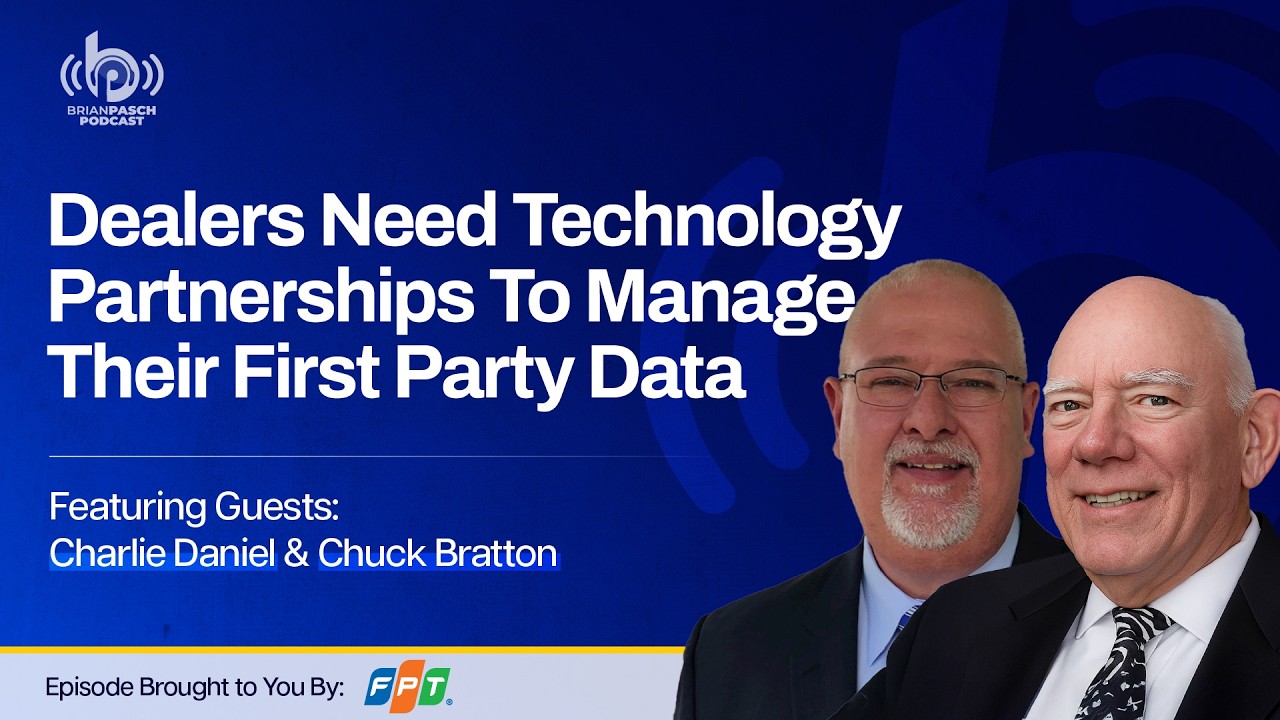
Dealers Need Technology Partnerships to Manage Their First-Party Data
Clean data, security guardrails and extra engineering: how FPT Americas helps dealer groups and vendors build on first-party data without waiting.
- Released
- July 16, 2026
- Length
- 35 min
- Guests

 Charlie Daniel, Chuck Bratton
- In collaboration with
 FPT Americas
In short
More dealer groups want to own their first-party data and build their own AI tools, but the data is often dirty, security is light and in-house skills are thin. Charlie and Chuck explain how FPT Americas fills those gaps for dealer groups, and how it gives software vendors extra engineering capacity for integrations and platform cutovers.
- Owning your data isn't enough if it's dirty. Charlie says one customer can sit in your systems five or six times under different emails.
- Clean data starts going stale the next day. Brian says the architecture has to be self-healing, for example finding a new email after a bounce.
- Be careful loading customer files into free AI accounts. Brian warns the data may not be secure and may be shared or learned from.
- Chuck says security has to be built into the architecture from the start, an approach called DevSecOps, rather than added later.
- As more agents touch customer data, Brian expects large groups to need a compliance traffic cop that agents check before calling, emailing or texting.
Chapters
- 0:00Why first-party data is a priority now
- 2:20A car guy's view of retail technology gaps
- 4:04The "only if" gaps and how FPT fills them
- 6:26Pillar one: clean data architecture
- 12:02Pillar two: security and guardrails
- 17:00Who controls opt-in and opt-out for agents
- 19:46Pillar three: helping vendors scale
- 26:24What owning your data really takes
- 28:17Closing thoughts from Charlie and Chuck
The conversation
Filling technology gaps without selling a competing product
Charlie has spent nearly 30 years in the car business, on both the retail and the software side, and calls himself a car guy, not a developer. His job at FPT is to build the roadmap: understand dealers' pain points and how technology fits the showroom. Brian describes the "only if" gaps he hears in planning meetings, such as wishing the CRM could talk to the loaner car software.
Chuck describes FPT as an engineering engine behind enterprise transformation. It doesn't build competing products. It modernizes technology, integrates complex systems and applies AI, cloud and software engineering to business problems, for dealer groups and for vendors. Brian says he hasn't had a guest before who will fill technology gaps on a project basis: tell them what you want, spec it out and build it together.
Most dealer groups own their data now, but it's dirty
Charlie says almost every dealer group owns its data, but it's dirty. The CRM, the service drive and the website each capture a different email address, so one customer ends up in the system five or six times, which makes marketing a nightmare. He bought a vehicle three months ago and is still getting emails asking about the trade-in he already handed over.
Brian has a similar story: a year and a half after trading in his Corvette, a Chevrolet store that had serviced it once asked to buy it. Chuck calls this the classic data problem. FPT is platform-agnostic, he says, and designs the architecture, integrates systems, manages data, secures cloud environments and helps with AI integrations. Brian adds that clean data starts going stale the next day, so the architecture has to be self-healing.
Almost every dealer group is owning their own data. But here's the problem. It's dirty.
Charlie Daniel▶ 7:02Guardrails and security before customer data goes into AI tools
Brian is concerned that dealers load customer files into free accounts on frontier AI models without knowing whether the data is secure, or whether it's being shared or learned from by default. Charlie points to the steady flow of FTC and federal compliance rules and to the risk created by every SaaS company that pipes into a dealer's data. He wants guardrails strong enough that the dealer stays protected even when another company connects through an API.
Chuck says security has to be built into the architecture, not added later, an approach called DevSecOps. FPT designs secure cloud environments on Azure, AWS and GCP and follows frameworks such as SOC 2: identity and access controls, encrypted data, continuous vulnerability management, penetration testing and secured data pipelines to third-party applications. He calls it business continuity, not just an investment.
As dealerships become more connected, cyber security really has to be built into the architecture, not added later.
Chuck Bratton▶ 16:00Who should control opt-in and opt-out when agents contact customers
Brian sees dealers building their own AI agents, an agent in the CRM, and third-party agents reaching into the DMS for declined service, recalls and service-to-sales. He ran a LinkedIn poll on who should coordinate opt-in and opt-out compliance across them, and a third-party layer won. He thinks large groups will need their own compliance traffic cop that every agent checks before it calls, emails or texts.
Chuck's advice is not to go it alone. The generative AI world has lots of leaky boats that let data out, he says, and a dealership shouldn't adopt an AI solution without a security management team that knows what data is used, how it's used and who is responsible for it. Those gates, he says, protect dealers from lawsuits and many other problems.
Extra engineering capacity for vendors behind on integrations
Brian turns to vendors that sign a large group and then struggle with its custom data and performance integrations, or whose OEM co-op program keeps asking for one more KPI. Chuck says FPT knows the auto ecosystem, including the DMS, repair orders, desking and dealership workflows, so it can integrate with legacy systems with very little ramp-up. It handles middleware and data integration so the vendor's own engineers can keep building features.
Charlie sees the pain on both sides: dealers feel nothing is happening, while the vendor pulls its lead developer off a project to fix an old system. He knows one vendor facing six-month integration times for a large group. FPT can supply a single developer, a pod of four or five, or a team of 50 or 60 who already know the language, he says, and the vendor keeps the credit.
Owning your first-party data means building, not buying off the shelf
Brian's closing thought is for large groups that say they want to own their first-party data. Nobody owns it completely, he says, because you still depend on AWS, Azure or Snowflake. But if the goal is control over functionality, data hygiene and high recurring fees, that isn't an off-the-shelf product, and it's time to get a quote. For vendors, he notes that one has an 18-month backlog, and switching barriers keep getting lower.
Charlie's message to dealers is to stop saying "only if", because the technology is available now and the first conversation costs nothing. He puts a value on each request so it has a return on investment that works for the dealer. Brian calls that value engineering: list your ideas and prioritize them by the value the organization will get.
Long development lead cycles, long product cutovers, or delays in promised functionality is a revenue problem. It's not just a customer retention problem.
 Brian Pasch▶ 32:37
Mentioned in this episode
- PGModern Retailing Conference Event
- CClaude
 Reynolds and Reynolds Vendor Directory
 Snowflake
- AAWS
- MMicrosoft Azure
- GGoogle Cloud
Questions this episode answers
What does FPT Americas do for car dealers?
Chuck describes FPT as an engineering engine behind enterprise transformation. It doesn't sell competing products. It designs data architecture, integrates systems, modernizes applications, secures cloud environments and helps with AI integrations for dealer groups and software vendors.
Why is dealership first-party data so often dirty?
Charlie says customers come in through several points, such as the CRM, the service drive and the website, each with a different email address. One customer can end up in the system five or six times, which causes problems for marketing.
Is it safe to put customer data into free AI tools?
Brian warns that data loaded into free frontier AI accounts may not be as secure as dealers think, and may be shared or learned from by default. Chuck advises having a security management team in place before adopting an AI solution.
What is DevSecOps?
Chuck describes it as building security into the architecture as you build, rather than adding it later. FPT applies it on Azure, AWS and GCP and follows frameworks such as SOC 2.
How can FPT Americas help software vendors?
By handling middleware, data integration and enterprise connections, or by adding developers who already know the language, from one person to a team of 50 or 60, so the vendor's own engineers can stay on the roadmap.
Can a dealer group fully own its first-party data?
Brian says no one owns it completely, because you still depend on a platform such as AWS, Azure or Snowflake. But a group can control functionality, data hygiene and recurring fees with a custom build.
Transcript
Full transcript5,025 words · about 22 min read
Brian Pasch0:00Hi, this is Brian Pasch and welcome to another exciting podcast today. I'm going to be introducing a company that you should already know about, but it's one of the best-kept secrets in the automotive industry and their timing is perfect. Their experience, strategy, and solutions are really helping dealers with their immediate needs today. In order to have that discussion, I'm bringing in Charlie Daniel. He's the head of automotive retail solutions for FPT Software and Chuck Bratton. He's the VP of solutions for FPT. Gentlemen, welcome to the show.
Charlie Daniel0:48Nice to be here. Thank you, Brian.
Chuck Bratton0:50Thanks, Brian.
Brian Pasch0:51You know, when I poll dealers today, it's quite interesting. There's been a transformation going on. Dealers having more awareness of the importance of their first-party data, which I think they've taken for granted. I'm hearing from marketing managers, even the dealer principals, fooling around with AI. Hey, I'm building this in Claude, or look what I'm doing with my Reynolds data to create a better financial product. And yet, at the same time, I'm asking myself, where are they putting their data? Is it secure? Who has access to it? And then one of the bigger questions that are still popping around in people's thoughts, it's no longer who has access to the data. Dealers are getting their data. But how do we control how we communicate to customers?
Brian Pasch1:47And today, for all the dealers and tech companies watching, I want you to learn a little bit more about FPT Americas and their IT services and solutions that can come and fill gaps in automotive retail process at the dealer group level. And also, for the vendor community, who may be under-resourced for this amazing surge of interest in APIs, MCPs, and new support for growing dealer needs. So let me start off with you, Charlie. Charlie, you are a car guy, not an automotive software engineer, but you have great experience in automotive retail. Let's talk about what you're hearing. What are some of the operational struggles that dealer groups are having today that you believe FPT is here to solve?
Charlie Daniel2:48Yeah, thank you, Brian. And actually, yes, no, I'm not a developer by far. I am a car guy. I've been in this business for a little over almost 30 years now. So it's been a while. But I've lived in this industry on both sides, which is kind of unique. I've lived on the SaaS side, and I've lived on the retail side. And a lot of my time over these decades has been connecting retail automotive to technology. So when FPT reached out to me and asked me to lead this vertical, it fit perfectly with what I've been focusing on pretty much a lot of my career was fixing the problems, finding the gaps.
Charlie Daniel3:34And I mean, retail can't live without technology nowadays, and technology definitely doesn't live without retail. So combining them and understanding the pain points and how the technology fits into the showroom is really key. And not being a tech guy, I look at it and go, why can't we do this? And that's where this all starts. So my job is basically to build that roadmap.
Brian Pasch4:04Yes. And Chuck, here's what I've heard. And Charlie, you and I have talked about this. It's oftentimes in a planning meeting, I hear a dealer principal or general manager say, only if, for example, only if my CRM could talk to my loaner car software, or only if I could know when my lifecycle marketing company sends out a mailer and what that mailer really said, so my internal team could be ready. So Chuck, give us a little background then for dealers who have only if needs that are gaps in technology that need to be filled and they don't want to wait. How does FPT Americas team up with dealer groups or, as I mentioned, vendors with explosive growth or needing to refresh outdated technology? How does it really work behind the scenes?
Chuck Bratton5:10Well, thanks, Brian. Thanks for having me on the show. So, well, when you think of FPT, think of us as an engineering engine behind the enterprise transformation. We don't build competing products. We help auto retail run better by modernizing technology, integrating complex systems, applying AI, cloud, software engineering to solve real business problems. So my role is really, from the company's perspective, is to understand how those technologies work, how they come together, what's the architecture behind them, and then support, you know, the connectivity, the development that supports growth, efficiency, and a better customer experience.
Brian Pasch5:58Well, I love the fact that we ran into each other and have the opportunity to educate because I don't think I've ever had someone on our podcast that is willing to basically fill gaps in technology on a project basis without, you know, ego. So just tell me what you want to do, just tell me what you want to do, let me spec it out, and let's build together. So let's start with the first of your foundational pillars that drives FPT Americas mission and its approach to automotive retail solutions. That is that data architecture. Charlie, you're talking to dealers all the time. What's some of their pain points when it comes to the foundational data in their dealership, especially more and more dealers are saying, I want to own my first-party data.
Brian Pasch6:58I'm not sure they know what that means. What are you seeing in the field, Charlie?
Charlie Daniel7:02Well, right now, you're seeing a lot of, almost every dealer group is owning their own data. But here's the problem. It's dirty. You know, as well as I did, you've got multiple points of entry. You have a CRM, you know, that is maybe three or four different entries by different, you know, email addresses. You know, your service drive is getting another email address. You know, your website is going to get another email address. I mean, I think we all have three or four or five different emails that we use, that we use on a daily basis. What happens is, is Charlie goes into your system five or six different times.
Charlie Daniel7:40And it's a nightmare when it comes to marketing, you know, multiplications, everything else that goes along with it. To give you a little bit of an idea of how it works, I just recently purchased a vehicle about three months ago. I'm getting emails from my old trade today. You know, they're still asking for my trade. And the vehicle was traded in three months ago. You know, I mean, how does that, I mean, let's forget about the stigma of how that looks at a dealership. Think about the marketing spend, you know, think about how everything ties in. I mean, it's, it's, it all starts with your data.
Charlie Daniel8:26I mean, to me, you could build the best tools in the world. If your data is not clean, that's where you get into the problems.
Brian Pasch8:33And Charlie, I'm gonna tell a story. It just happened this week. So I live in, in Boca Raton area. I had bought a 2020 Corvette when it first came out from one of my clients up North Jersey. I just drove it on literally Sunday to church. After five years, it had 3,000 miles on it. So I decided to trade it in. I'm getting too old to get down that low in the Corvette, honestly. And so I, I traded in for a Cadillac, beautiful Cadillac at Vera Cadillac down in Miami. And that was a year and a half ago. I took my car once to Lou Bachrodt Chevrolet.
Brian Pasch9:18That was down my house. I took it in service once I've received just this week. Hey, uh, we really need Corvettes. And, uh, you know, we'd like to give you a top dollar now a year and a half that would give them enough time to see that that vehicle was sold. It's under new ownership, but the service marketing company is completely separate from reality. And here we go again with the perception. Here's my perception. Lou Bachrodt has no idea who their customers are or what vehicles they own. And so, um, Chuck for dealers who are listening, especially dealer groups that are saying, I want to own my first party data.
Brian Pasch10:03I'm going to build my own thing. Um, I always tell them, do you have any experience in that? Uh, and oftentimes it says, no, but I heard it's not that hard. So let's put, uh, kind of some reality checks. How does FPT Americas help dealers practically now who want to own and manage and activate their first party data?
Chuck Bratton10:30So this is the classic data problem. And that's really where we, we fit in to the ecosystem. So we don't really have a product to sell or a platform that we're trying to push. Um, so our advice is driven by what's the best customer experience. We're agnostic when it comes to platforms, services. Um, we understand all the tooling. So our role is to provide that engineering behind the scenes, um, design the architecture, integrating systems, modernizing applications, excuse me, managing data, securing cloud environments and helping with AI integrations. So we enable software companies, uh, to scale more effectively and help dealerships get that full return on the technology they invest in.
Chuck Bratton11:17So when the infrastructure is connected and the data is trusted, innovation kind of happens faster.
Brian Pasch11:24And, and I just want dealers to understand it's more complicated than you think. And more importantly, even once, as Charlie mentioned, you clean your data, uh, the next day it starts to get stale. So any data architecture that you built has to have what I call a self healing architecture. So if emails go out and they bounce the data lake or the, uh, automation infrastructure, we'll process that, mark the record, look for a new email address. These are all things that people don't always think about because their vendors never talked about them. Um, Charlie, I want to go to the second pillar of FPT Americas strategy.
Brian Pasch12:08And this is this idea of, if a dealer is going to own and activate and update their own data, there needs to be some guardrails and there needs to be some security around the data. I'm, I'm a little concerned that dealers don't understand some of them that when they're loading up their customer files in some of these, you know, frontier AI free accounts that that data may not be, um, as secure as they think, or maybe it's by default being shared or learned. Uh, so these AI models actually learn something about your company that you never intended them to learn about. So Charlie talk about the second pillar, which is creating guardrails and security for customer
Brian Pasch13:01data.
Charlie Daniel13:02All right, Brian, so to kind of give you an idea of what the guardrails would look like in, in, in a data, data aspect of it, we all, our guardrails used to be our gut. This is pretty much what it was. Um, nowadays, I mean, guardrails can be used in so many different facets of, of, of the industry when it comes to data. Think about all the compliance regulations that are coming from FTC, everything, I mean, we are getting hit nonstop right now with, with different compliance, federal regulations. Everything else is coming down the pipeline from the federal government. It's, it's, it's putting a lot of, a lot of headache on us, you know, we, for me, I sit
Charlie Daniel13:46down and I talk to the dealership and understand exactly, not just the overview, but fine tooth details of, I mean, imagine looking for a 2019 F-150, you know, a short bed at Lariat. Well, guess what? There's seven or eight different builds just in a lot in that model. You know, so we have to get really, really defined on what it is. What are you looking for? What are the guard, guardrails that you, that you're doing? The same aspect goes into the securities. Who do we allow in? Imagine everybody that pipes into your, into your data. That's a risk. So think about all the SaaS companies that you have.
Charlie Daniel14:31They have securities. But what if, what happens if, you know, you need to protect your security, your data.
Brian Pasch14:40Right.
Charlie Daniel14:41And build the guardrails around that and make it military grade, you know, to the point where that even if someone else that is API into your, into your system, you're still protected based on your, your platform.
Brian Pasch14:56You know, and Chuck, I want you to go into some more specific details because I don't hear too much of this in the automotive podcast circles, but what I'm seeing dealers building their own AI agents, then dealers have an AI agent in their CRM. And then we have third party agents that want to take a dip into the DMS to do decline service recalls, uh, service to sales opportunities. And then I start to say, wow, how many people, uh, are now accessing with very light security? And then how do we control the cadence? So I want you to talk about two things. Um, this idea of how FPT Americas helps dealers avoid the blunder of rushing into first party
Brian Pasch15:56data management without the right security.
Chuck Bratton16:00Okay, so first, um, as dealerships become more connected, cyber security really has to be built into the architecture, not added later. That process is called DevSecOps. As you build something, you build security in it to make sure that it functions properly. So we at FPT design cloud secure environments on all the hyperscalers, Azure, AWS, and GCP. And we follow the, the recognized, um, security frameworks like SOC 2, um, that really includes identity, access controls, encrypted data, continuous vulnerability management, uh, penetration testing, and, uh, securing that data pipelines that connects those third party applications. Really the goal is simple. You really want to protect the customer data, you know, maintain that compliance and keep the
Chuck Bratton16:50dealership operating without disruption. You know, so it's all about being good security. Um, it's not just an investment, really. It's, it's all about business continuity.
Brian Pasch17:00You know, Chuck, one of the thing I've been struggling with, and I brought it up on polls at conferences. I recently did a LinkedIn poll and asked who should be coordinating the communication and compliance of opt-in and opt-out, uh, with all these agents. And I gave choices, uh, you know, is it the DMS? Is it the CRM company? Is it a third party company? And the winner was a third party, you know, company or layer, you know, I'm thinking, let's just think of a large organization like AutoNation or, you know, uh, very successful operators, Berkshire Hathaway, Morgan Auto Group, Keating Auto Group. Um, they're going to always want to test new products, new agents, new strategies, but still
Brian Pasch17:51remain compliant. And I'm thinking that for larger dealer groups, they're probably going to have to build their own compliance kind of traffic cop, uh, to make sure that opt-in and opt-out signals and where they come from properly weighted so that agents always have to check, you know, with the, the compliance cop to say, are, are we right now still able to call or email or text? What do you think about that? It just seems like there's no standard for that and dealers love testing things and dealer groups have the complexity of many balls in the air at one time.
Chuck Bratton18:33Yeah. You really don't want to go out on the reservation by yourself. Um, the gen AI universe, large language learning, all those tool sets, uh, they're all, um, it's a, it's a growing industry and there are lots of leaky boats in it, um, that make, make it very porous for data to leak out. Um, I wouldn't suggest, um, um, um, uh, a dealership on their own without a security management team, helping them understand what it means when you're allowing that data to be used and what data is being used and how it's being used, who's responsible for it. Um, all those gates have to be in play, um, before you can really truly adopt, uh, an AI
Chuck Bratton19:17solution. AI is great. It has a lot of functions and features and functionality that will, will continue to, to grow over the next decade to, you know, what we see in the future is even more amazing than what we see today, but it's having those guardrails. It's having, you know, that security compliance, um, alignment to what's best practices will keep you safe from all kinds of lawsuits and, uh, and, and actually many other problems that can be, you know, affected.
Brian Pasch19:46Let's, let's turn to the third pillar, which is the engine, the productivity, the scalability of SaaS solutions. Once data is organized and once data secure, then building the applications that turn that data into proper communications or to products into revenue into profitability is where FPT also excels. So let's flip the switch a little bit. Let's just say that dealer groups understand now that FPT Americas can come in alongside help with data hygiene and architecture, help with security and guardrails and help them implement, um, bespoke applications. But the flip the script is talking about our automotive vendor colleagues who may sign a big group and then feel overwhelmed because that group, uh, agreement required integrating of their custom data,
Brian Pasch20:54like integration of their performance metrics. I see this, um, all the time, Chuck, let's dive into this. And then Charlie, I have you comment on as well, but it's not uncommon that large dealer groups, because I've seen these, uh, enterprise agreements, they come with a lot of bells and whistles, or even a vendor who now is in an OEM co-op program and the OEM, by the way, every month seems to ask them for one more thing, one more integration, one more KPI, one more feature. How does FPT come alongside the vendor community and fill those gaps when enterprise contracts land, new opportunities, uh, exist, or they're getting way behind in converting legacy software
Brian Pasch21:44to modern architecture?
Chuck Bratton21:47Right. Another age old problem and just every industry that we deal with, uh, no one's, um, can hide, but, you know, has any place to hide from that problem because enterprise software is disruptive. Um, and it's all, it's good. I mean, it works, but it can always, it can be disruptive, but, um, because we really understand the, the auto ecosystem, including the DMS, repair orders, desking, dealership workflows. We can integrate with those legacy systems, um, quickly and very, very little ramp up. This is where we really add value. We, we handle the middleware, the data integration, the enterprise, uh, connections. This really allows our customers, engineering teams to stay focused on their daily support, um,
Chuck Bratton22:34building new features and functionality and existing platform services. And it really, they can, I can do all that instead of having to be pulled away to integrate for that custom integration for every deployment of every, every SaaS product. Um, we do this often, um, and we're really good at it. We understand how it works and how to make, you know, the, the, the experience better for the client. It's, it's really all about that client experience.
Brian Pasch23:03Yeah. And, and, uh, Charlie, I was having a little chuckle the other day, cause I was thinking of you in regard to this vendor communication. So I'm working with a vendor who cut over from their legacy software platform, which everyone loved and super stable to their new platform. And I said, you know, let me talk to some of your customers. And some of the customers said, man, I love it. Others are like, man, this platform was so reliable in this one area, but this one's buggy. And I said, well, how long have you been, you know, trying to get these bugs fixed? It's like a couple of months.
Brian Pasch23:38And here's what I heard. It's like, that's too long. Um, Charlie, I think, uh, you and I have talked to a number of vendors where cutting over from old platforms and new platforms are taking longer or just fixing bugs. They just don't have the bandwidth when something falls apart. What are you telling the vendor community, Charlie, on how FPT can, uh, be their backstop, be their partner. And I like what Chuck said, the smartest, most innovative people should be talking about the product roadmap and working on the product roadmap, not bogged down in 10 hours a week of legacy cut over meetings. What are you saying to the vendor community, Charlie, who, um, are struggling with some
Brian Pasch24:31of these platform upgrade challenges?
Charlie Daniel24:35Well, I mean, and Brian, you nailed it. I mean, this is a real pain point for both sides. I mean, in coming from both sides, I can see it. The dealership side gets really upset because it's like nothing's happening. The tech, the SaaS side is sitting here going, I'm having to pull my lead developer off a project to fix this old legacy system. You know, and it is just, it doesn't make any sense because I mean, everybody knows that they have their roadmap that they go with and they're, they're planning out years down the road.
Brian Pasch25:10Yeah.
Charlie Daniel25:10And when you run into, and I've got one right now that is signs of signs of pretty large dealer group and they're looking at integration times of six months.
Brian Pasch25:21Yes.
Charlie Daniel25:22Well, I mean, guess what? Because they're so heavily into the new development, everybody's getting ready for NADA, everybody's playing way ahead of time. And this is where the IC, the FPT fits so well with inside of the SaaS platforms is because regardless if it's a single point, if it's a single developer that you're looking for, if it's a pod of four or five, if it's a team, you know, up to 50 or 60, we have the scale. I mean, we have thousands and thousands of developers right here that already know the language. There's zero ramp up time. So we don't have to, there's not weeks and months of going, okay, this is the language that
Charlie Daniel26:08we use.
Brian Pasch26:09Yes.
Charlie Daniel26:09We already know. We've been doing this for decades. So it's just, we do it behind the scenes. We don't, we want you to take all the, all the credit. We just need to fix it and get it done.
Brian Pasch26:23Yeah. And, and I think that's the breakthrough in closing. I had some thoughts about our conversation. I've been thinking about this a while as I'm talking to larger dealer groups. Here's what I'm hearing all the time. Brian, we want to own our first party data and I don't want to be obligated to X and forget the name. It's, it's not just one name. So here's my thought dealer groups who say, I really want to own my first party data. Okay. There's no such thing as totally owning it because whether you're on, uh, uh, AWS or Azure or some other, uh, platform, Snowflake, you're still depending on someone.
Brian Pasch27:02But when you're talking about software functionality, hygiene, and, and maybe really high recurring fees that you don't want to pay, then stop complaining and call FPT Americas for, uh, a quote for those services that if you really want to back up your words, like I want to own and control my destiny. Great. That's not an off the shelf product. And if that's the direction and larger dealer groups can afford that same thing with, um, some of the vendors. And, and I, I'm thinking one vendor who has an 18 month backlog and I know another vendor has a six month backlog and you might sound like that is great, but 18 months is an eternity in tech land.
Brian Pasch27:51So whether you're a dealer group who saying, what if, what if, what if, or I want to own, I want to own, I want to control, I want to see, then it's time, uh, to take action. If you're a vendor is saying this cutover is taking too long and our customers are complaining, remember the options, the barriers of switching are getting lower and lower all the time. So retention is key. Charlie, I'm going to start with you and then go to Chuck. Give me a closing thought on how, uh, you see FPT Americas as being a win-win for dealer groups and for the vendor community.
Charlie Daniel28:30Well, for the vendor community, basically we are your extended IT services. I mean, you're, we're your extended, extended developers, you know, regardless of what amount of size you need, we have the capability for the dealership side. Stop saying only if, because guess what? It's available now. And, and I, and I spent a lot of time hearing dealerships complaining going, well, only if I could do this, only if I could do that. And today's technology, it's available. And I mean, easier than ever before of, you know, the capabilities to be able to get it done. I mean, it doesn't cost anything to sit down and discuss it.
Charlie Daniel29:12You know, and the biggest part about that is, is what you may want is may not be exactly what you're going to do, what really works best for you. And that's where I come in. We sit down and we put a value to actually what the ask is. And we make sure what you're looking to obtain has a return on investment that actually works well for you.
Brian Pasch29:39And I think that's so important, Charlie. I call that value engineering. Like I have 10 ideas. Let's prioritize them based on the value that the organization will get. Chuck, I love the fact that you mentioned you have zero product bias. Hey, you want to be on AWS, you want to be on Azure, you want to use Snowflake or not? Who cares? Let's focus on solutions, not products to sell to other companies, but solutions for the dealership, building out a solid infrastructure. Put a bow on this, Chuck, for the dealer groups and the SaaS companies listening in today. What's something that we miss you wanted to be really clear about to them?
Chuck Bratton30:34So really, our focus is on building that infrastructure, those integrations and that engineering that connects the technologies our customers already have invested in. When those systems work together, SaaS providers can scale faster, dealerships get more value from their technology investments, and everyone benefits from a more connected ecosystem. And that's what we deliver. We've walked into organizations where they have 100 different platforms that they're currently using, and they've just invested in a large SaaS product. And the SaaS companies, which are great, will come in and say, here's what we have, but then they're not able to connect that to all the different platform services, because the dealerships are not going to give up all 99 of the other services.
Chuck Bratton31:23They may give up some of them, and they need someone who can come in and scale and look at their system and help them make that change.
Brian Pasch31:32Yeah, it's so important. Well, I want to thank everyone who are listening in today or listening in in the car. I want to encourage you, if you have been doing what if, what if, or I want to control, I want to change, I want to own. If those conversations at the dealer group level, I want to eliminate waste, I want to coordinate the cadence of communication and control who is communicating. Those conversations need bespoke solutions, and I'm going to show a QR code here on the screen, which can go to a landing page where you can set up a time to meet with Charlie and Chuck and start those conversations.
Brian Pasch32:17Same message to the vendor community. Remember, competitive edge can erode quickly. The speed at which software is being developed is amazing, but doesn't mean it's secure or scalable. But everyone knows now that these sprints are getting shorter and shorter. Long development lead cycles, long product cutovers, or delays in promise functionality is a revenue problem. It's not just a customer retention problem. It's a revenue problem. So, again, use this QR code, and also you'll see the URL of the website. Either go to the landing page or scan the QR code, but get an appointment just to scope out what it would look like to partner behind the scenes with FPT Americas.
Brian Pasch33:12Charlie, Chuck, thanks so much for your time. This is a much-needed and timely conversation as dealers really think about the future of what is involved with first-party data management, bespoke AI tools, and, well, doing more with their data that they've never, ever been able to do before. It's here. Charlie said, the wait's over, the lead time is collapsing. Now it's time to take action. So scan the QR code, get an appointment set up, and keep in mind that there are dozens of interviews with automotive leaders, disruptors, and, well, conversations about the future of automotive retailing. So make sure you look at other episodes of our podcast.
Brian Pasch34:00And remember, this November, the Modern Retailing Conference is coming to Palm Beach, Florida, and we're going to be talking about the things that are impacting retailing today. Some really meaty conversations, including some of the things we talked about here. So go to modernretailingconference.com, get your tickets. It sells out every year. The agenda this year is going to be amazing. So I hope to see you in Palm Beach, Florida, in November. That's all for now. Charlie, Chuck, thanks for your wisdom and insights, and I'll see you next time on another Pasch podcast.
Ask your AI about this episodeOpens your assistant with a summary prompt and a link to this page.
More episodes
All episodes- Sep 27, 2026
Foureyes Empowers AI Builders: The Next Generation of Retailing Software Is Here
Dealers built dashboards and apps on Foureyes' open data platform at the Claude for Dealers workshop. What they learned about data access and trust.

 David Steinberg, Melody Edwards
 Foureyes41 min
 - Sep 23, 2026
AI Builders Now Have API Access to the Active Shopper Network
Client Command opens its Active Shopper Network to any dealer, vendor or AI builder through an API, so call lists and audiences start with real intent.

 Megan Horton, Wally Burchfield
 Client Command28 min
 - May 6, 2026
A Fresh Perspective on Automotive AI Strategies
Why AI agents should be trained like new hires instead of bolted on like software, and what dealers should measure in the first 90 days.
 Albert Thompson
 IDPrivacy.ai48 min
Never miss an episode
Follow the Brian Pasch Podcast wherever you listen.