Road to DMSC
BizzyCar Revolutionizes Recall Marketing, Retention Strategies, & Mobile Service
BizzyCar texts owners about open recalls and uses AI to book the visit. How recalls bring back lost customers and make mobile service pay.
- Released
- April 24, 2025
- Length
- 30 min
- Guest
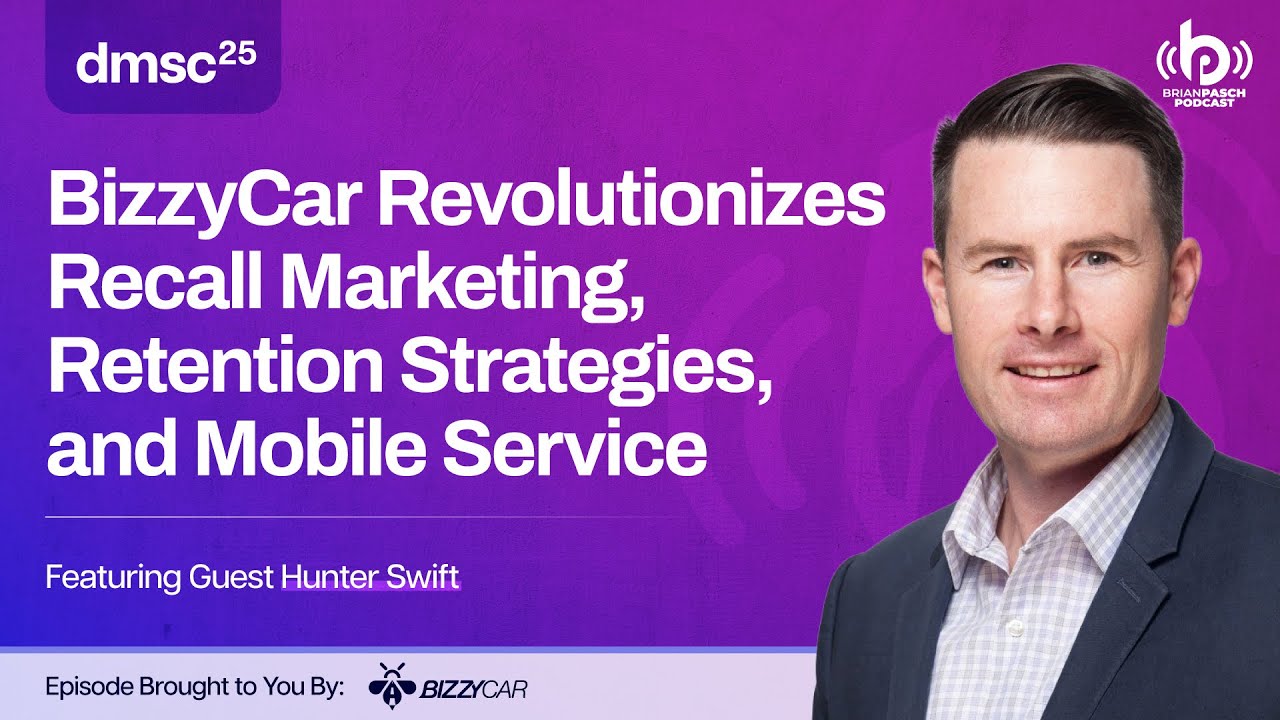
 Hunter Swift
- In collaboration with
 BizzyCar
In short
Recalls are the one repair customers have to bring back to the dealer, and they cost the customer nothing. BizzyCar uses them to reach customers who haven't been in for a long time, add open recalls to appointments already on the books and fill mobile service schedules, with AI texting doing the outreach and booking.
- Hunter says recalls have a compliance exemption, so owners can be texted about a recall without an opt-in because safety trumps privacy.
- The average customer BizzyCar reaches hasn't visited in 600 days, Hunter says, so each recall appointment is a chance to win back a lost customer.
- Hunter says about 60% of customers told about an open recall in the service drive decline it, mostly because they didn't plan for the time.
- Texting customers about an open recall before their appointment lifts acceptance by 50%, Hunter says, and replies can add it straight to the RO.
- Treat every recall visit as an at-bat: a multipoint inspection, a trade appraisal and a future appointment before the customer leaves.
Chapters
- 0:00Bringing fixed ops into the conversation
- 0:58Built by a dealer to fix recall outreach
- 2:41Why recall mail and BDC calls fall short
- 4:20The recall exemption and AI texting
- 4:52Dirty DMS data and data hygiene
- 8:24Used cars, fleets and the return
- 14:37Making mobile service profitable
- 17:29Recall Scout and the service drive
- 22:20Mobile service as a retention tool
The conversation
Dealers don't have a recall problem, they have a retention problem
Hunter Swift, VP of Marketing at BizzyCar, says the company was built by a dealer. CEO Ryan Maher, a third-generation dealer at St. Charles Automotive Group outside St. Louis, created it to reach customers with open recalls. One in four vehicles has an open recall, Hunter says, and 27 million vehicles were affected by a recall last year.
BizzyCar started out to help dealers complete more recalls, but found their real problem is retention: bringing customers back while facing compliance limits on outreach, bad customer data and competition from local mechanics and quick-lube shops. Recalls are the one service dealers have exclusively. Customers can get an oil change or a repair anywhere, but a recall has to come back to the dealership, at no cost to them.
Dealers don't really have a recall problem. They have a retention problem.
Hunter Swift▶ 1:57Why recall mail and BDC calls fall short
Hunter says mail costs $2 to $3 a piece once postage is added, converts poorly and keeps going to people who no longer own the vehicle, because nobody updates the CRM when the yellow forwarding sticker comes back. To lift response, dealers make mailers look like a bill or add a $50 discount to a $200 to $300 repair order.
The biggest frustration with recall mail, he says, is parts: customers call or arrive unannounced and the part isn't there. BDCs don't like making calls, customers don't answer unsolicited ones, and marketing texts raise spam and TCPA issues. Recalls have an exemption, Hunter says, so BizzyCar texts owners without an opt-in and uses AI to answer their questions and book the appointment.
Recall outreach only works with clean data
Brian shares data from a hygiene project with the Morgan Automotive Group presented at the Modern Retailing Conference in 2024: over 40% of the vehicles in seven years of DMS transactions were no longer owned by that customer. The DMS records a past transaction and isn't updated, so recall mail sent from it is largely wasted. Cell phone numbers change far less often than addresses.
Hunter says the reply BizzyCar gets most often to its first text is "I don't own this vehicle anymore," which it can report back so the dealer can fix its records. Brian sees a fit with CDPs: each recall visit is a new transaction, which gives the dealer another 18 months of permissible contact and a reason to talk about trade-ins and equity.
Recalls on used cars and fleets, and what the visit is worth
BizzyCar also finds recall work outside the dealer's own customers. Hunter says the product started when Ryan, under OEM pressure during COVID, searched a VIN on Google, found the car listed on AutoTrader at a dealership across the street and offered the free repair. BizzyCar now books recall appointments for used car lots and fleet departments as well as consumers, on average 30 to 50 extra appointments a month with no work from the dealership.
Each visit is an at-bat for an inspection, more service, a trade appraisal and a future appointment. Hunter says the product costs about $1,100 to $1,400 depending on the product, the average dealer sees about 8x ROI and top dealers 20 to 30x. The average customer BizzyCar reaches hasn't visited in 600 days.
I've never left the dentist without a future appointment. But why do we let our service customers leave our dealership without a future set appointment?
Hunter Swift▶ 10:29Recalls make mobile service profitable
Many recalls can be done by mobile service, some with just a laptop, and Hunter says about 60% of them qualify. Booking a mobile visit for a set time means the technician has to arrive on time, so BizzyCar built a mobile service app with the day's schedule and parts list, turn-by-turn navigation, customer notifications, inspections with photos and video, and mobile payment, plus a real-time dashboard for the mobile coordinator. It is also sold on its own.
The question dealers ask about mobile service is how to make it profitable, and Hunter says oil changes alone won't do it. Because BizzyCar books recalls, each mobile repair order gets extra line items that make the visit pay. Brian mentions a client in Miami whose mobile pickup service, started before COVID, sent his fixed ops absorption through the roof.
Most recalls flagged in the service drive get declined
Dealers often say they already check for open recalls when customers arrive. Hunter says BizzyCar's study found about 60% of customers told about a recall in the service drive decline it: the check is manual and often missed, customers didn't plan for an extra hour or more, or the part isn't in stock. Brian had the same experience with his Honda Pilot and five or six software updates.
BizzyCar's Recall Scout, launched this year, scans the DMS for upcoming appointments with open recalls that aren't on the repair order and texts the customer ahead of the visit. Hunter says that lifts acceptance by 50% even without a reply, and a reply adds the recall to the RO. BizzyCar gets recall, TSB, campaign and parts data from the OEM every night, so it can say how long the repair takes and whether the part is in stock.
I believe that dealers win on the retention game and the lifetime value of a customer has a lot to do with their experience in the service drive.
 Brian Pasch▶ 21:18
Mobile service as retention and extra capacity
Hunter says there are close to 4,000 mobile service vans in the country and Ford dealers have it down. One BizzyCar customer, Bozard Ford in Florida, runs close to 40 mobile vehicles, treats mobile service as retention rather than a profit center and reports close to 100% CSI. At St. Charles Hyundai, an entry-level driver in a wrapped Tucson completes about seven recalls a day.
Brian sees a capacity play. Dealers at maximum service capacity, thinking about a second shift or landlocked with no room to expand, could move low-pay, fast-turnaround work such as recalls to mobile service and keep the bays for higher-value repairs. Hunter agrees: why clog the drive with work you can do via mobile?
Mentioned in this episode

Questions this episode answers
What does BizzyCar do?
BizzyCar texts vehicle owners about open recalls and uses AI to answer their questions and book the service appointment. It also offers Recall Scout for upcoming appointments and a mobile service app for dealers running mobile service vans.
Can dealers text customers about recalls without an opt-in?
Hunter says recalls have an exemption that allows outreach without an opt-in or opt-out, because safety trumps privacy. Marketing texts don't get that exemption and raise spam and TCPA issues.
Why do customers decline recalls in the service drive?
Hunter gives three reasons: the check is manual and often missed, customers didn't plan for the extra time, and the part often isn't in stock. BizzyCar's study found about 60% decline.
What is BizzyCar's Recall Scout?
A product that scans the DMS for upcoming appointments with open recalls not yet on the repair order and texts the customer ahead of the visit. Hunter says acceptance rises 50%, and a reply can add the recall to the RO.
Which DMSs does BizzyCar integrate with?
Hunter says BizzyCar works with every major DMS and every service scheduler, because it needs that data to book appointments and add recalls to repair orders.
How many extra service appointments can recall outreach add?
Hunter says BizzyCar adds 30 to 50 appointments a month on average, with no work required from the dealership. He puts the average return at about 8x, and top dealers at 20 to 30x.
Transcript
Full transcript5,303 words · about 23 min read
Brian Pasch0:00Hi, this is Brian Pasch, and welcome to another exciting podcast interview today. It's so great to have longtime friend Hunter Swift on today's podcast. He is the voice between the dealer and a new company as the VP of marketing for BizzyCar. So today, we're going to dive in. And see what Hunter's up to. Let's learn about how BizzyCar is filling an important gap for dealers in the area of fixed operations. We've had so many people on variable ops. So, hey, I'm evolving this podcast to help all departments of the dealership. And there's no better person to bring on as we push in the fixed ops than Hunter. So, Hunter, welcome to the show.
Hunter Swift0:56Yeah, thanks for having me.
Brian Pasch0:58So, BizzyCar had an interesting evolution. Let's start from the beginning. When the company was first formed, what was it focused on?
Hunter Swift1:08Yeah. So, our company is actually built by a dealer. So, our CEO, Ryan Maher, is a third generation car dealer out of St. Charles Automotive Group outside of St. Louis, Missouri. And he struggled just like every single dealer and found a need and said, "Hey, this doesn't exist. Let's go out and create a product." And he was able to create BizzyCar. And I think when we first came out, you know, we realized that there were a lot of recalls. One in four vehicles have an open recall. Last year, there was 27 million vehicles that were affected with a recall. And recalls is, you know, a huge problem. It affects the vehicle reliability and the safety.
Hunter Swift1:45And so, he saw this great opportunity to say, "Hey, I have a way to reach out to these customers." And as you mentioned, you know, our company and our product evolving, I think initially we looked at our goal of just helping complete more recalls. But what we've ended up finding out that dealers don't really have a recall problem. They have a retention problem. And they're trying to bring customers in, especially with, you know, the slow sales that are probably going to come up with the auto tariffs and things like that.
Brian Pasch2:11Right.
Hunter Swift2:11There's more reliance on trying to bring customers in. And, you know, we have compliance issues in regards to how we can reach out to customers. We have data issues in regards to finding the right customer. And then we have all this competition trying to figure out, you know, how do we, you know, be local mechanics and Jiffy Lubes. And so, this was the problem that kind of was at hand. And what we realized is there needed to be a better way. And so, we created BizzyCar. And at its core, we helped set appointments for people to come in with recalls. Now, managing recalls isn't new. A lot of dealerships as well as, you know, our owner was using traditional mail. They had call, you know, calling.
Brian Pasch2:50BDC.
Hunter Swift2:52Right. And so, what we realized is, you know, one, mail has a low conversion rate. You know, it's costly in the sense of, you know, by the time you add postage and everything, it might be $2 to $3 a postage. And surprisingly, you know, dealers are sending out thousands of mailers and then they all come back with that little yellow sticker that says they don't, you know, live there anymore. And no one goes and updates the CRM. And so, every month, they continue to send out mail to people who don't own these vehicles. And it's just a very low conversion rate or you have to trick the customer into thinking it's a bill or a credit card and offer, you know, a $50, you know, discount. And when you're thinking about a $200 to $300 RO and giving away $50, like that's a lot of revenue.
Hunter Swift3:32And so, mail really hasn't solved this problem. But the number one frustration that people have with mail is actually parts availability. Because you have people that are notified of these recalls. They come in. They call in and then they can't get it done. Yeah. And so, they're in your drive unannounced. And then you say, sorry, we don't have the part. And so, although they're trying to do a good deed of notifying them of the recall because of the process or the archaic technology or what have you, it creates a negative experience. And then, you know, as you mentioned, BDC, BDCs don't like making phone calls, you know, especially reaching out to people like customers don't like to be, you know, answer calls unsolicited. And so, it's really difficult.
Hunter Swift4:09And then if you look at the traditional ways that people are usually marketing to customers, either mail or by text, you have a lot of compliance issues with spam and TCPA and things like that. And so, what we've been able to identify is recalls actually has an exemption. And so, we can actually reach out to people without an opt-in or an opt-out because the FTC has proven that or allowed us an exemption to say that safety trumps privacy.
Brian Pasch4:35That's right.
Hunter Swift4:36So, what we're doing is we're leveraging recalls as a way to reach out to these customers. And instead of traditional methods like mail or phone calls, we do it through texting, which has a high open rate. And then we incorporate artificial intelligence to interact with these customers and set the appointment.
Brian Pasch4:52So, that's a lot to unpack. So, let me make a few comments to the dealers who are listening in. Hunter brings up an amazing point about direct mail. And I'm just going to use an example of data that we shared at the Modern Retailing Conference in 2024. We did a data hygiene project with the Morgan Auto Group and over 40% of the transactions in the DMS over the last seven years for Morgan, over 40% were no longer owned by that consumer. So, you have to understand that since the DMS is a transactional record of time passed, the DMS's aren't being updated. So, any outreach you're doing for recalls by default, unless this transaction happened within the last year and you maybe have a 5% or 6% data degradation, it's a huge waste of time.
Brian Pasch5:53So, mail costs go up, cell phone numbers, though, don't change very often. Just think of your own, you know, personal cell. And so, today that companies can fill in missing cell phone data or email data using data append tools, CDPs, I think, Hunter, are going to be a boon for you.
Hunter Swift6:18Yes.
Brian Pasch6:19Because you can pull now in clean data, use your texting platform with AI to connect. I also want to hit up with your realization that you've become a retention tool.
Hunter Swift6:33Yeah.
Brian Pasch6:35It's so critical, and we're going to get into what that success rate looks like, but dealers need a reason to communicate with their customers. Now, there's a lot of benefits. As soon as you have another transaction, you have another 18 months of permissible use to reach out to customers, right? There's a limit to the transaction and how many times and how long you can contact. So, you reset the clock on communication. You have an opportunity to have a new conversation about trade in, equity, what the car is worth. But you have to get in touch with the customer. So, Hunter, I love texting. I love the fact that recall safety is a priority.
Brian Pasch7:23So, if the dealer sold that car to a person, they can reach out. What does that connect rate or engagement rate look like? Meaning, dealers who did it the old way, like, let me send out dirty mail from my DMS, or let me send out dirty emails from my DMS. What is the delta in revenue that you've seen with dealers?
Hunter Swift7:49Yeah. So, I mean, first off, I mentioned about mail. No one is reaching out to the dealer saying, "Hey, I don't own this vehicle anymore. I don't want to quit mailing me." No, it just doesn't happen. The first text message that we get most back from customers is, "I don't own this vehicle anymore." And so, we're getting an updated right away that we can then report back to the dealer if they wanted to and actually go through the process and say, "Hey, this customer doesn't own these vehicles." Unfortunately, as I mentioned with the corrected address, a lot of dealers aren't updating this, and they should.
Hunter Swift8:19And it's literally a hole where they're leaking money. But, you know, we're making sure that we're sending it to the right customer. The other thing that we do in regards to our outreach is, not only are we trying to find customers within our own database, but we realized that there were vehicles that were for sale at local dealerships in our area that had open recalls as well. And so, that's actually how the product initially started was Ryan during COVID when it was slow was getting pressure from the OEM to complete some recalls. But those customers weren't in his database. So, all he did was he put that VIN number into Google.
Hunter Swift8:53It found a listing for AutoTrader and saw that that vehicle was for sale at a dealership across the street. So, when sales were slow and people weren't coming in, he picked up the phone, called the dealership across the street and said, "Hey, I'd like to offer this free repair." And so, if you think about all the used car lots and the dealerships that are selling competitor brands, if you're trying to sell one and you could say, "Hey, it was just at the dealership. It just got this repair, you know, recall done." Every time you bring it into service, you're always getting like a MPI. So, it just helps, right?
Hunter Swift9:22But it's low hanging fruit for these dealers. So, we're not only just setting appointments for consumers, but we're also setting it for used car lots and other lots as well as fleet departments. Because a lot of these fleet departments have, you know, like let's say, you know, a Ford fleet. They might have air conditioning or, you know, or transport or delivery that are all using Ford trucks. Well, they might all have recalls, but they don't have time to do all those, you know, bring them into service. So, they can bring a mobile truck or they can do somebody, you know, go to their facility when they're closed and knock off all these repairs.
Hunter Swift9:52And so, you know, at our core, our goal is, like you mentioned, to create like an at-bat for these dealers. And if the dealer maximizes this at-bat, right, you mentioned, right, you can sell additional services, you can do MPIs, you could do trade appraisals. So, that's the key. So, usually, like our product is about $1,100 to $1,400, depending on the product. But our average dealer sees about an 8x ROI. Our top dealers see 20 to 30x ROI. They're the ones that are maximizing this at-bat, right? They're not just doing the repair and letting them leave, but they're saying, hey, you know, let's do this. Like, simple best practices, like, you know, I've never left the dentist without a future appointment.
Hunter Swift10:35But why do we let our service customers leave our dealership without a future set appointment, right? When somebody is in there making sure that you're doing a trade appraisal on every single vehicle. Like, if a dealership starts doing these in this process, they're looking at us as, like, you're creating all these great at-bats. The number one stat that I love with BizzyCar is our average customer, the last day since last visit, is 600 days. So, these are lost customers, right?
Brian Pasch11:03I love this, Hunter, and I want to go back to one thing. I love the fact that for dealers who have CDPs who are looking for a specific AI outreach to generate revenue, this is a no-brainer. This is a no-brainer. But here's the other thing I love. I love the fact that BizzyCar's AI texting can confirm that they own the car, and if they don't, then the CDP can be updated. I mean, data hygiene is so important, right?
Hunter Swift11:37Yeah.
Brian Pasch11:38What does this customer have? I love the fact that you guys have thought about, hey, generating revenue from used car or fleets. I love it because it has to be automated to do it, right?
Hunter Swift11:51Yeah.
Brian Pasch11:52No one is going to look for these opportunities. So, Hunter, when we think about this outreach, what can an average dealer, you know, and I know it varies on the size of the database, right?
Hunter Swift12:10Yeah.
Brian Pasch12:11But an average store, are they booking another 10, 20, 30?
Hunter Swift12:16Yeah. So, usually, on average, you could say we add about 30 to 50 extra appointments a month. And this 30 to 50 appointments required zero involvement from the dealership. So, they didn't have to log into a tool. They didn't have to learn a new tool. All they had to do was just create a positive experience and do the work. And so, that's one of the nice things about our product is it's completely independent. And as we kind of talked about this at bat, the reason why recalls is such a great thing is you forget that this is the one thing that dealerships have exclusivity on.
Hunter Swift12:51Everything else, so oil change, you know, major and minor repair, they can do elsewhere. It's the only thing that has to come back to the dealership. It doesn't cost the consumer any money. So, this is your, you know, competing against a $19 oil change, right?
Brian Pasch13:05Right.
Hunter Swift13:06Like, this is a free service, right?
Brian Pasch13:07Right.
Hunter Swift13:08And, you know, when you start thinking about this opportunity of engaging with these customers, because of the AI, we're not just notifying them that they have a recall. We're not sending a text message with a link to schedule it online, which requires them to take an extra step, which most, if you go to any, you know, Xtime or online service scheduler, it's actually, you can't even set a recall appointment. Because there's so many, like, no one's updating all of the opcodes.
Brian Pasch13:33That's right. The opcode spaghetti is.
Hunter Swift13:35Yeah. So, they're often setting generic recalls that doesn't allow the dealership to be prepared. It doesn't know what the parts in stock. And so, one of the big things that kind of separates us from any other marketing company, because you could have a texting company all of a sudden start sending out text messages or marketing company, right? But the big thing for us, like our secret sauce is that we get direct recall data directly from the OEM every single night. This includes TSB, campaign information, as well as parts. So, as we're communicating with the customer about their, their recall, they often have questions like, is it safe?
Hunter Swift14:08What is it going to take? How long is it going to, you know, take for it to be repaired? You know, is the part in stock? Those are all things that we do to interact with these customers. And we are interacting with these customers, you know, multi, it's a long outreach, right? So, as people don't respond, you know, we'll continue to outreach. But once we start interacting with them and our integration with the scheduler, it just, like, when can you come in? We set it. They get a notification. We send out text follow-up if they missed the appointment or reminders. And it's just this very simple process.
Hunter Swift14:37Now, the challenge that we had was a lot of these recalls can be completed via mobile. And there's a lot of really big push with mobile service, especially with Ford. And so, we were actually setting mobile appointments for these customers. But if you've ever had anyone come to your house, like a plumber or the cable, when do they usually come?
Brian Pasch14:55Yeah. They just say, basically, stay home and waste your whole day. Yeah, sometime between nine and five.
Hunter Swift15:01And so, that wasn't working when we were trying to set appointments. And so, as we were setting appointments for, like, 9:00, 10:30, 12:00, we needed to make sure that they got there on time. And so, we actually created a mobile service app that the mobile technician has that gives them an idea of what their day looks like, what parts they need to have on the park. Because, obviously, we want them to be upselling wipers and filters.
Brian Pasch15:22Right.
Hunter Swift15:23But it gives them turn-by-turn navigation. It helps them get to the appointment. It notifies the customers in route. We allow interface within the app to do an MPI inspection, photos, videos, notify the customer when it's done, even mobile payment. And so, once they're done, then they get routed to the next appointment. And we have a dashboard for the mobile coordinator who can see all the vehicles in real time. And, you know, there are some other, you know, things that we do in regards to that. But, and it is a standalone product as well. But what we realized was, as mobile service was starting to be introduced, the number one question that dealers had was, "How do I make this profitable?"
Brian Pasch15:58Right.
Hunter Swift15:59And so, if you're just trying to do mobile service and just trying to do oil changes, it's not. Because of the fact that we do recalls, it instantly adds additional line items to these repair orders that now make it more profitable, right?
Brian Pasch16:13I love that. I love that because, you know, I have a client in Miami who, prior to COVID, decided to do, you know, mobile pickup. And it totally transformed his business that his fixed or fixed ops absorption is through the roof. So, I'm wondering if he ever thought about this because he's a very progressive guy. And, yeah, not everyone maybe wants to do mobile servicing. I just love the fact that you can communicate the text is specific to the recall. You know what parts are needed. So, let me ask the question that we really didn't address is when the customer is scheduling the recall service appointment at the dealership.
Brian Pasch17:09Do you have integration with all the major DMSs? So, Reynolds and CDK, Dealertrack, Tekion. Tell me who you integrate with today.
Hunter Swift17:19Yeah, we work with every major DMS and every service scheduler. We have to, right? We have to be able to get access to this data. And so, that's a big part of it. Now, the other interesting thing that when we introduced our recall appointment setting process, the number one objection that we'd always get was, well, I already have a process in my store that when they come in, the first thing I do is I check if they have an open recall. And what we realized through an intensive study is about 60% of the customers who are notified in the service drive of a recall decline it.
Hunter Swift17:53And the reason why, one, is it's a manual process that is often overlooked. The second and the largest one was expectation, meaning they allotted a two-hour job, you know, they rearranged their schedule. They've got kids they've got to pick up. They get there and they say, hey, you have an open recall. They ask, well, how much longer is it going to take? Oh, an extra hour and a half. Oh, I wasn't planning on it. And then they would decline it. And then the third one was you had people that are notified, but you don't have the part in stock. You can get the part in tomorrow.
Hunter Swift18:21And now you're asking somebody who set an appointment seven days ago who we knew that they were coming in and they had an open recall instead of actually doing it. So that was like a hurdle that we had to overcome because, you know, people said we had a process in place. And so just recently, but the process wasn't meeting customer expectation. It wasn't efficient.
Brian Pasch18:41I, my personal experience, um, I have a Honda Pilot. I went into the dealership I bought it for. And they're like, um, there's like, uh, five or six software updates have to be applied. And I'm like, well, how long that's going to take? And they said anywhere from 45 minutes to an hour and a half. And I said, I got other appointments to go to. I wish someone would have told me, or, you know, can I do these software updates at home? Which at that point I couldn't. Um, you're absolutely right. Setting the expectation, um, advising the customer to prepare or drop off or get a loaner car just makes so much sense.
Brian Pasch19:23Especially since the vehicle, the parts and the time required or allocated for the recall is all part of your data set.
Hunter Swift19:35Yeah. So we, so because of that, we created a new product that we launched this year called Recall Scout. And what it does, it scans the DMS for upcoming appointments that have open recalls, but that line item isn't attached to the RO.
Brian Pasch19:49So smart.
Hunter Swift19:50So then we incorporate our same texting AI outreach and say, Brian, you're coming in for service on Thursday. We just want to notify you that you have an open recall. And again, because we have all this data, we can integrate because your first question is going to be just like you asked how much longer is it going to be. But by us preemptively letting you know, even if you don't interact with us, we see a 50% increase in accepting it because now you're aware and you already allotted that time. If they actually interact with us, we can add it to the RO. The advisor doesn't have to do anything.
Hunter Swift20:20And so the way that we're able to do that is through our DMS and service integration or service schedule integration. And so we, we really kind of wrap the bow on, you know, we're reaching out to people and then we're reaching out to people who are coming in. And then that's why mobile service was like a good kind of transition, because what if they won't come to us? Well, now we can come to them.
Brian Pasch20:38Right.
Hunter Swift20:39And so it expands.
Brian Pasch20:40This is well, well thought out, Hunter, because as you mentioned, you're making existing appointments more profitable and a better customer experience. You're reaching lost customers. You said average of 600 days old. Okay. And for more progressive dealers who say, look, I don't mind managing a fleet of mobile service repair. You're making it easy for them to know how to load the truck each day, where to go and to maximize revenue. Again, it's about customer experience. And I want to remind dealers that it's through the service drive. I believe that dealers win on the retention game and the lifetime value of a customer has a lot to do with their experience in the service drive.
Brian Pasch21:28I mean, I think of a very famous retailer in New Jersey. I grew up in New Jersey, Ray Catena. And people rave about service experience. In fact, there's a lot of snowbirds, Hunter, that go from New Jersey to Florida. And as part of his customer service experience, he picks up their cars, ships them down to their summer house. I mean, like, I don't know many car dealers that help snowbirds with their cars, but that's part of the Ray Catena customer experience. I love this because I don't like surprises. I really work with a tight calendar. And if you can get me in and out or come to my home and do the recall, man, that's so much better than anything I've heard or experienced before.
Hunter Swift22:19Yeah. So, I mean, what you're talking about convenience is a really important tenet of what we do. Like, we make it convenient to notify the customer. We make it convenient for them to set the appointment. We make it easy to have a great experience. And, you know, I think mobile is definitely a new progressive thing. Like, Ford dealers are maxed. Like, they've really got it down and see the value. I think there's, like, close to 4,000 mobile vans in the country right now. And I've got dealers like BizzyCar customer, Ed Bozard, or Ed Roberts at Bozard Ford. I mean, they're close to 40 vehicles fleet in Florida.
Hunter Swift22:55And so, what he told me was he actually doesn't even look at mobile service as a profit center. It's purely retention. And he says it's close to a 100% CSI mobile service. Because these customers, like, I'm busy at work all day, right? I can leave my car in the driveway, have somebody come fix it. Like, how is that not good for me?
Brian Pasch23:18I know.
Hunter Swift23:19Most customers are driving around with, you know, notices and service reminders. And they're neglecting it because, as we mentioned at the beginning, right? It's just not convenient. And so, by making this convenient for them, this whole process, you're seeing incredible CSI. The other thing I want to talk about mobile service is, you know, a lot of times, you know, you forget, you want your drive filled with the stuff that you can make the most amount of money at. So, why clog it with anything that you can do via mobile, right?
Brian Pasch23:48So smart.
Hunter Swift23:50Right? So these dealers who are getting this are realizing that, you know, you can expand your reach. You can go past your PMA. It's a mobile billboard. You're offering great service. And if you can help set these appointments and get them to them without any involvement, then it's just a win-win all the way around.
Brian Pasch24:06And that's why I just thought something that what you just said. And I know a number of dealers who say, man, I'm at max capacity in my service bays, and I'm thinking about adding a second shift. But, you know, that creates another whole set of problems. I'm landlocked. I don't have room to expand. I wonder if they really thought what it could be like if they were able to remove, like, hey, 20% of this low-hanging fruit, which could be done on mobile service. Could that give them the extra bandwidth, the extra profitability to justify an investment in a mobile service fleet? I love everything about this.
Hunter Swift24:50And it's crazy because the technology, especially with, like, the Ford Transit, like, those are big. Like, I've got dealers that have alignment machines, an oil-changing machine. Like, they can put a vacuum at the top of the oil so that when they take out the plug, it's not leaking any oil. And they, you know, they're doing tire rotation. They're doing a lot more repairs than you think that you can actually do. They're doing via mobile. But as I mentioned, you know, 60% of recalls can be done via mobile. A lot of them can be done just with a laptop and a plug-in. Like, at our dealership, St. Charles Hyundai, they got a Hyundai Tucson, spent $800 to wrap it.
Hunter Swift25:24And instead of taking their service technicians who are skilled and you want them working on cars, they took an entry-level guy that's good with people, that didn't mind driving, that could complete these recalls. And they're doing about seven a day. And for Hyundai, you know, one of the issues they had was the 993 recall was the social media one where people could start stealing Hyundais with, like, a USB or something like that.
Brian Pasch25:47Right, right.
Hunter Swift25:48And they were trying to do all these efforts and events to try to get these to come in. But because it was inconvenient, they still weren't getting these things done. And we can set these appointments. And I've got a driver now that this is all he does. And he just drives around. He does this. But it gives us an at-bat. It resets the clock. It allows us to do an inspection that says, hey, I noticed there's something wrong. Let's schedule that appointment to come in. And so when you think, when I said, you know, I know you mentioned it, but, like, just to really hang on this.
Hunter Swift26:17600 days since last visit. These are lost customers, right? And so if you can think about just getting that opportunity, like, what would you pay? Like, when somebody says, well, how many appointments? And you say, oh, 30. Well, 30 is not that important. Well, what if half of those you haven't been in contact with 800 days, 1,000 days? What's the value of that customer?
Brian Pasch26:39Yes. No, no. I think smart operators who are listening today's podcast, some lights are going off. Whether it's I'm reaching lost customers without any effort on myself. Number two, I'm creating a better customer experience when a car comes in that has a open recall. Number three, I'm potentially removing low pay, fast turnaround, you know, services which can be done on a mobile experience. There's so many revenue opportunities here. I think this will be one of our most listened to podcasts. I know I'm going to be promoting it because especially, especially with all that dealers are faced with, with profit challenges, retention challenges, this makes complete sense.
Brian Pasch27:30Hunter, if a dealer wanted to learn more about the platform, what's the website and is there a general sales email address that can be shared?
Hunter Swift27:43Yeah. So our website is just bizzycar.com. And then if you want to email anyone, you can just do hello@bizzycar.com. But yeah, thanks for having us. We're excited to be on this podcast and be part of the DMSC event. Um, you know, as you mentioned, uh, most of the times it's variable, but when we can talk about fixed and this is, this is bigger than just fixed, right? Like we're, this is the retention. This is going to help sell additional cars. Um, and then the other thought too, cause we did talk about the BDC, you know, think about if I can take this off their plate now, what can they do now?
Hunter Swift28:15Right. So there's just so much involved in this program and, and then we feel good because not only are we helping dealers make more money, but we're making the vehicles that people are driving more safe. Right. We're, we're saving lives.
Brian Pasch28:29I love it. Hunter. This is a great, uh, timing for this product, especially as dealers invest in CDPs, especially as dealers are looking to get communication clocks reset, uh, create engagement, great conversations. This is a perfect way to stimulate conversation and engagement and even reset some data in the CDP. Well, Hunter, thanks for coming on the show. Look forward to DMSC. Thank you for supporting dealer education. Um, the DMSC event in Scottsdale is going to be our largest. It's an amazing location. We'll be in Scottsdale every year going forward. And, uh, for the dealers who are listening in, take a moment to go to bizzycar.com and get information on this platform.
Brian Pasch29:19And if this is the first time you're listening to one of my podcasts, um, you should know there are hundreds of interviews with dealership leaders, entrepreneur, tech giants, people who are reinventing automotive retail. So just search for the Brian Pasch podcast and listen in to these great conversations. I thank you for your time. Hunter and I enjoyed, um, the fact that you joined us and look forward to sharing time with you again on a future podcast session. Thanks again.
Ask your AI about this episodeOpens your assistant with a summary prompt and a link to this page.
More episodes
All episodes- Sep 27, 2026
Foureyes Empowers AI Builders: The Next Generation of Retailing Software Is Here
Dealers built dashboards and apps on Foureyes' open data platform at the Claude for Dealers workshop. What they learned about data access and trust.

 David Steinberg, Melody Edwards
 Foureyes41 min
 - Sep 23, 2026
AI Builders Now Have API Access to the Active Shopper Network
Client Command opens its Active Shopper Network to any dealer, vendor or AI builder through an API, so call lists and audiences start with real intent.

 Megan Horton, Wally Burchfield
 Client Command28 min
 - Jul 16, 2026
Dealers Need Technology Partnerships to Manage Their First-Party Data
Clean data, security guardrails and extra engineering: how FPT Americas helps dealer groups and vendors build on first-party data without waiting.

 Charlie Daniel, Chuck Bratton
 FPT Americas35 min
Never miss an episode
Follow the Brian Pasch Podcast wherever you listen.